Best Inventory Management Software for Small Businesses in the UAE: 12 Features to Compare
 General
Best Inventory Management Software for Small Businesses in the UAE: 12 Features to Compare
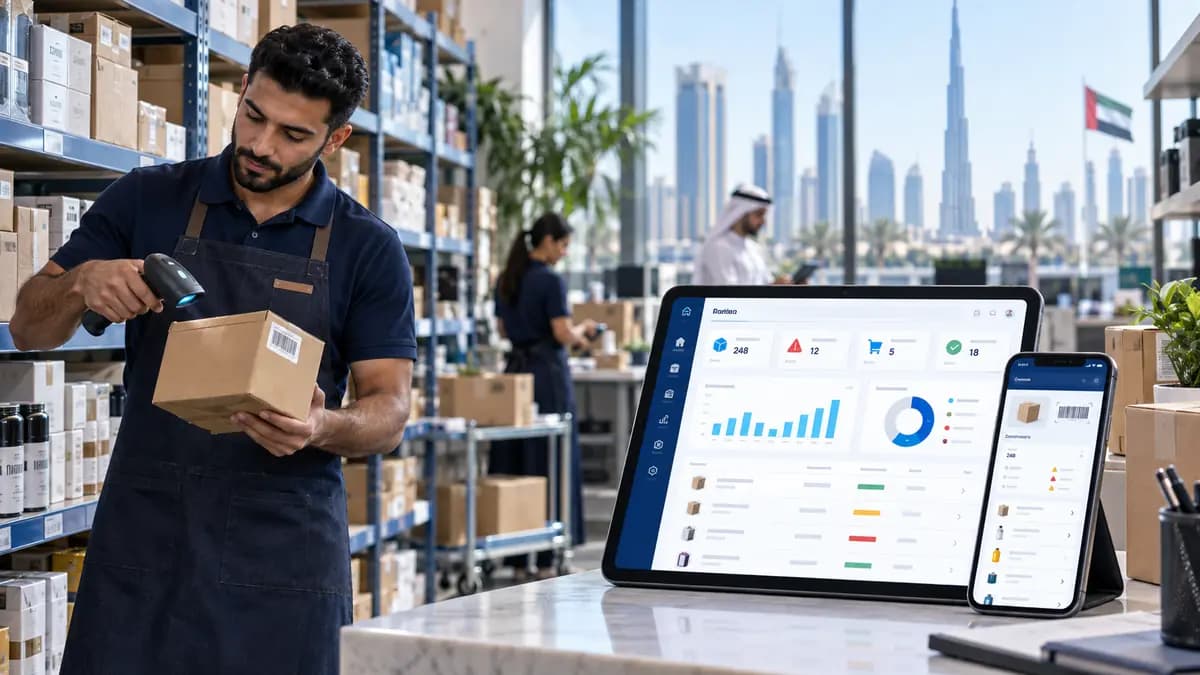
The best inventory management software for small businesses in the UAE is usually the system that combines warehouse control, barcode workflows, accounting integration, and local implementation support in one platform. For retailers, distributors, manufacturers, and multi-branch SMEs, the real comparison is not feature volume; it is whether the software can handle UAE tax records, imported stock costs, multiple locations, and fast-moving sales channels without forcing teams back into spreadsheets.
In practical terms, inventory management software for small businesses should give you accurate stock visibility, cleaner purchasing decisions, and tighter links between sales, finance, and operations. Platforms built on ERP architecture, including Odoo-based setups, are often shortlisted because they can connect inventory with purchasing, POS, eCommerce, accounting, and approvals rather than treating stock as a standalone module.
Inventory management software is a system that records stock movement from receipt to storage, transfer, sale, return, and adjustment while maintaining usable data for costing, valuation, replenishment, and reporting. In the UAE, that definition matters because inventory records affect VAT treatment, audit readiness, and corporate reporting, not just warehouse efficiency.
1) Warehouse accuracy starts with stock control depth, not just item lists
Multi-warehouse control prevents blind spots across emirates
The first buying criterion is whether the software can manage multiple warehouses, internal locations, and branch-level transfers without duplication. Many UAE SMEs hold stock in a Dubai showroom, a Sharjah warehouse, and a van or service vehicle, so one central quantity figure is not enough. You need location-specific on-hand, reserved, incoming, and outgoing stock so a transfer from Al Quoz to SAIF Zone is recorded as a controlled movement rather than a spreadsheet adjustment.
Barcode scanning should work at receiving, picking, and counting
Barcode support is most valuable when it reduces operational error at every touchpoint, not only at the till. A good system should support receiving against purchase orders, put-away, picking, packing, cycle counts, and returns using scanners or mobile devices. For SMEs processing dozens of SKUs per day, barcode validation helps stop common mistakes such as receiving 48 units when the supplier delivered 84.
Replenishment rules should trigger action before stockouts hit sales
Reordering logic matters more in the UAE because supply chains often include imports, local distributors, and variable lead times. The right platform should allow minimum and maximum levels, vendor lead times, route-based replenishment, and exceptions for seasonal items or project stock. According to Dubai Chamber, the UAE e-commerce market is projected to reach USD 9.3 billion by 2025, which raises the cost of inaccurate stock availability across online and offline channels.
2) Traceability and costing separate usable systems from basic stock apps
Lot and serial tracking is essential for regulated and high-value items
If you sell cosmetics, medical-adjacent products, spare parts, electronics, or optical items, lot and serial tracking should be non-negotiable. The system should record which batch or serial number was received, sold, transferred, or returned, and it should make that history searchable by customer, supplier, or document. In Odoo-based workflows, this is especially useful for after-sales support because teams can trace a specific unit back to its receipt and procurement record.
Expiry-date management matters for perishables and shelf-life sensitive stock
Batch control is only half the requirement; UAE buyers should also check whether expiry and removal-date rules are supported. This is important for food, supplements, cosmetics, chemicals, and optical consumables where old stock can become a compliance and margin issue. A capable system should alert users before expiry, support FEFO-style operational handling where appropriate, and keep disposal or write-off transactions visible to finance.
Landed-cost calculation must include freight, duty, and clearing fees
For import-driven businesses, item cost is rarely just the supplier invoice value. The software should allocate freight, customs duty, insurance, and local clearing charges across receipts using a defined costing method, so margin reports reflect true landed value in AED. This is one area where standalone stock apps often fall short, while ERP-led systems can connect purchase receipts, vendor bills, and costing journals in one flow.
3) Sales-channel integration is now a core inventory requirement
POS integration keeps showroom and warehouse quantities aligned
Retailers comparing systems should ask a direct question: does a sale at the counter update stock immediately and post the financial effect correctly? For a small business with one store today and three next year, disconnected POS creates overselling, manual reconciliation, and delayed branch visibility. Integrated setups are particularly useful for optical retail, spare parts, and specialty trading where stock must move cleanly between front-of-house and back-store locations.
eCommerce and marketplace integration reduces overselling risk
As online demand grows in Dubai and Abu Dhabi, stock data has to move between your inventory platform, web store, and marketplace accounts fast enough to prevent selling unavailable items. Buyers should look for API readiness, order import rules, shipping-status updates, and the ability to reserve quantities when online orders are confirmed. That matters whether you sell through your own site, Amazon.ae, Noon, or a custom B2B ordering portal.
Accounting integration should support VAT, valuation, and audit trails
Does the inventory software support automated UAE VAT treatment and usable accounting records? It should create a clean link between receipts, sales, returns, stock valuation, cost of goods sold, and tax-relevant invoices so finance teams do not rebuild reports manually at month-end. Businesses moving away from Tally or desktop-only accounting tools often choose unified ERP because FTA-facing records are easier to control when stock and finance share the same data structure.
For businesses evaluating a more connected setup, Codex has already outlined the operational side in this guide to Odoo inventory management software, which is useful background before comparing vendors.
4) Daily usability decides whether the system will actually be adopted
Mobile access matters for receiving, counting, and approvals on the move
Warehouse teams do not work from desks, and neither do branch managers or van sales supervisors. The software should offer mobile-friendly screens or scanner-based workflows for receiving, transfers, counts, delivery confirmation, and exception approvals. For UAE distributors operating across industrial areas and customer sites, mobile execution is often the difference between real-time stock and end-of-day backlog entry.
Permissions need to be granular enough for growing teams
A small business may start with one stock controller, but growth quickly introduces branch staff, buyers, finance users, drivers, and supervisors with different responsibilities. Good inventory software should let you control who can edit costs, validate transfers, backdate transactions, see branch inventory, or approve write-offs. That protects stock integrity and reduces the risk of accidental or unauthorized adjustments affecting valuation.
Reporting should answer operational and financial questions without exports
The final core feature is reporting depth. Buyers should test whether the system can show stock aging, turnover, valuation, margin by item, shortages, slow-moving inventory, purchase lead times, and location-wise availability without heavy spreadsheet work. When Odoo is configured well, these reports can be filtered by warehouse, company, item category, salesperson, or branch, which helps SMEs make faster purchasing and pricing decisions.
5) Compare implementation quality, budget logic, and fit before you buy
The twelfth buying criterion is implementation support, because software selection fails when processes are not mapped properly. Ask each provider how they handle item master cleanup, opening balances, barcode design, user roles, testing, training, and cutover. A credible partner should discuss warehouse routes, approval flows, VAT touchpoints, and integration dependencies before promising timelines.
Cost comparison in the UAE should be broken into three parts: software subscriptions or licenses, implementation services, and ongoing support. For a small importer or retailer, the cheapest quote can become the most expensive if landed costs, POS sync, or accounting journals are left for a later phase. Budget in AED against measurable outcomes such as reduced stock adjustments, faster month-end reconciliation, fewer emergency purchases, and better branch visibility.
Implementation timelines vary by complexity. A single-site business with a clean item list and limited integrations may move much faster than a distributor with multiple warehouses, serial tracking, imported goods, and eCommerce channels. The most common delay is not software configuration; it is poor source data, inconsistent units of measure, and undocumented approval rules.
One practical way to compare options is to score each vendor against the same criteria.
| Criterion | What to verify | Why it matters in the UAE |
|---|---|---|
| Multi-location operations | Warehouses, branches, vans, inter-location transfers | Common across mainland and free-zone operations |
| Costing and finance | Landed costs, valuation, VAT-linked accounting entries | Supports margin control and cleaner records |
| Sales connectivity | POS, eCommerce, marketplace, shipping APIs | Prevents channel-level stock mismatches |
| Execution and control | Mobile use, barcodes, permissions, approvals | Improves speed while protecting data quality |
| Partner capability | Process design, migration, training, support | Determines whether the system is adopted properly |
Odoo fits well when you need inventory to work as part of a broader ERP rather than a separate stock app. That is particularly relevant for trading, manufacturing, and van-sales workflows where purchasing, warehousing, accounting, and field execution need to stay connected; Codex covers that approach in its Odoo inventory and warehouse management software solution. If your team is comparing platforms now, use these 12 criteria as a shortlist framework and book a consultation to review fit, implementation scope, and realistic next steps for your operation.
Related Articles
- Best Optical Chain Management Software Features
- Manufacturing Erp Software Dubai For Small And Medium Businesses
- Optical Inventory Management Software Odoo
- Looking For Odoo Inventory Management Software Heres What You Need To Know
- Why Odoo Erp Is The Preferred Choice For Growing Businesses In Dubai
- Odoo Erp Implementation Services What Optical Businesses Must Ask Before Choosing An Erp
Inventory Management Software for Small Businesses UAE
Compare inventory management software for small businesses in the UAE with 12 practical features, Odoo fit, costs, and implementation tips.
Related solution: Odoo Van Sales Solution explains how Codex handles this workflow for UAE businesses.
Need a van sales rollout for your field team? Review the Codex van sales solution for route planning, mobile ordering, stock control, invoicing, payments, and daily reporting. Explore Odoo Van Sales Solution or talk to Codex for a guided consultation.
Frequently Asked Questions
What should buyers check before choosing inventory management software for small businesses in the UAE?

How can businesses compare inventory software providers?
What does inventory management software typically cost in the UAE?
How long does implementation usually take?
What security or compliance factors matter in the UAE?
Can Odoo manage VAT, landed costs, and batch expiry tracking?