Why Odoo ERP Is the Preferred Choice for Growing Businesses in Dubai
 Odoo
OdooDubai's small and mid sized businesses are scaling faster than spreadsheets and disconnected tools can support, and that gap is exactly why Odoo ERP Dubai searches keep climbing month over month. Multi branch operations, VAT compliance, and real time inventory tracking all demand one connected system instead of a dozen separate ones. Odoo ERP Dubai adoption brings sales, accounting, inventory, and customer relationships together on a single platform built for how growing Dubai companies actually operate, rather than forcing teams to reconcile numbers across five different tools every month end.
In this guide, you will learn why local businesses are switching to Odoo ERP Dubai solutions, what sets Odoo apart from generic international ERP software, which modules deliver value first, and how to judge whether the platform fits your own operation before you commit budget and staff time to an implementation.
Key Takeaways
Odoo ERP Dubai adoption is rising because it unifies finance, inventory, sales, and HR in one system built around UAE compliance needs.
Modular pricing lets growing businesses start with core modules and add functionality as operations expand, without a full system replacement later.
Working with a local Odoo Partner in Dubai reduces deployment risk through UAE specific VAT setup, data migration, and staff training.
Why Dubai Businesses Are Outgrowing Legacy Systems
Many Dubai SMEs start on QuickBooks, Excel, or a single point solution and outgrow it within two or three years of steady growth. Sales data lives in one tool, inventory counts live in another, and finance reconciles both by hand at month end. That manual work slows decisions and introduces errors right when leadership needs accurate numbers most. Companies that switch to an experienced Odoo ERP company typically report faster reporting cycles and fewer reconciliation errors within the first two quarters after go live.
The pattern shows up across industries. A trading business juggling multiple warehouses needs live stock visibility, not a weekly count. A contracting firm managing several active projects needs one system tracking costs, payroll, and procurement together. Businesses that streamline operations with a single ERP platform avoid the duplicate data entry that legacy tools force on growing teams, and they free up staff time for work that actually grows the business rather than maintaining it.
Leadership teams often underestimate how much revenue disconnected systems quietly cost them. A stockout that could have been prevented with real time visibility, a late VAT filing caused by manual data entry, or a missed follow up because sales and service records never synced all add up. That is the operational pain point driving Odoo ERP Dubai adoption among companies that have simply outgrown what worked when they were a five person team, and it is why so many owners start searching for the best ERP software in Dubai once growth exposes the cracks in their existing setup.
What Makes Odoo Different From Other ERP Software
Odoo stands apart from traditional ERP platforms because it is modular by design. A business does not have to buy or configure the entire suite on day one. Instead, teams can start with accounting and inventory, then add CRM, HR, or manufacturing modules only when operations actually need them. That flexibility matters for Dubai SMEs balancing growth against budget, and it is one reason companies working with an experienced Odoo ERP company tend to reach full adoption faster than teams that try to configure every module at once. Choosing the right Odoo company also shapes how well the platform is configured for your specific workflows from the very first deployment.
Odoo also ships with UAE specific localization out of the box, including VAT compliant invoicing and Arabic language support, which many international ERP platforms only offer as costly add ons. Businesses evaluating options against broader enterprise software solutions consistently find that Odoo's open architecture and active partner ecosystem make it easier to customize than closed, license heavy platforms built for a different market.
Pricing structure is the other major differentiator. Traditional enterprise ERP platforms often charge per module license plus a mandatory implementation package that can run into hundreds of thousands of dirhams before a business processes a single transaction. Odoo ERP Dubai implementations scale that cost to the business, letting a ten person trading company and a two hundred person contracting firm both run the same platform at a price point that matches their actual usage.
Core Modules Growing Businesses Use First
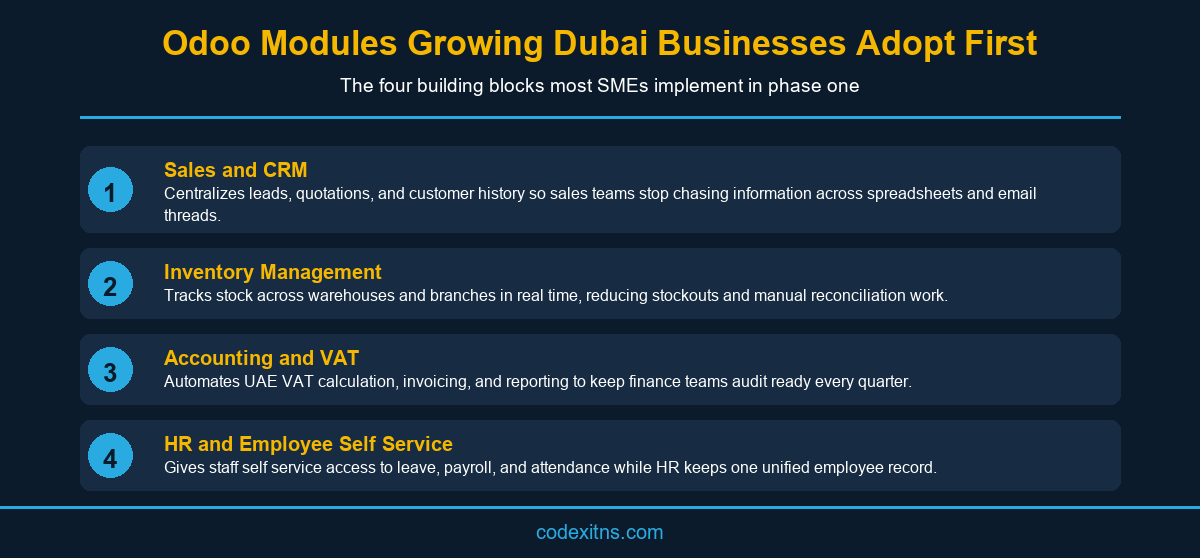
Most Dubai businesses running an Odoo ERP Dubai implementation roll it out in phases rather than all at once. The first phase usually covers sales, inventory, and accounting since these modules deliver the fastest visible return. Retail and trading companies exploring inventory management software often start there because stock accuracy has a direct, measurable impact on revenue and customer satisfaction.
HR typically follows once the core operational modules stabilize. Companies adopting the Odoo HR module alongside the HR and employee self service app give staff direct access to leave requests, payslips, and attendance records, cutting down the manual admin load on HR teams. Service oriented businesses that need CRM and field operations working together often reference how Odoo lets small teams integrate CRM and service operations without hiring a dedicated IT department.
The order matters more than businesses expect. Rolling out every module at once overwhelms staff and slows adoption, while a phased approach lets each team master one workflow before the next module goes live. Most successful Odoo ERP Dubai rollouts follow this sequence: finance and inventory first to stabilize daily operations, then CRM and sales to support growth, then HR and any industry specific modules once the core system is running smoothly.
Cost, Compliance, and Scalability Advantages in the UAE
Cost is usually the deciding factor for growing businesses comparing ERP options. Odoo's modular pricing means a company only pays for the modules it uses today, which keeps the platform accessible even for teams that could not justify a large upfront ERP budget. That accessibility is a major reason Odoo has become central to small business success stories across the UAE market over the past few years.
Compliance is the second factor. UAE VAT rules require accurate, auditable invoicing, and Odoo's accounting module handles that natively rather than through a bolted on plugin. Businesses researching ERP software solutions UAE companies can trust to stay current with local tax authority requirements, and the UAE's own federal tax guidance makes clear how much documentation businesses are expected to keep on hand at any given time.
Scalability closes the case for most growing companies. A business that starts with Odoo ERP Dubai adoption at ten employees does not need to migrate to a different platform at one hundred employees. The same system simply grows with additional users, modules, and integrations, which removes the disruptive replatforming projects that legacy systems eventually force on successful businesses.
Choosing the Right Odoo Implementation Approach
Even the best software fails without the right implementation partner. A structured Odoo ERP Dubai rollout typically starts with an Odoo consultation and process analysis phase to map current workflows before any configuration begins. Skipping this step is the most common reason ERP projects run over budget or miss deadlines.
After go live, ongoing support matters just as much as the initial setup. Businesses that plan for post go live support and maintenance from the start avoid the slow feature decay that happens when a system is configured once and never revisited. For a practical framework on vetting providers, see our guide on choosing your Odoo partner in Dubai, which covers the questions worth asking before signing a contract.
A Silver Partner status also matters here. It signals a proven certification track record with Odoo directly, not just familiarity with the software. Businesses evaluating an Odoo development company should ask about partner tier, prior deployments in their industry, and whether the provider handles both implementation and long term support under one contract.
Conclusion
Odoo ERP Dubai adoption keeps growing because it solves a real problem: disconnected tools slowing down businesses that are ready to scale. Modular pricing, native UAE VAT compliance, and a wide partner ecosystem make Odoo one of the most practical ERP choices for SMEs in the region today. The businesses that get the most value from Odoo ERP Dubai implementations are the ones that plan their rollout in phases and work with a partner who understands local compliance from day one, rather than treating the project as a single, all or nothing switch.
If you are ready to see how Odoo fits your operations, contact Codex for a free consultation and a realistic roadmap built around your business, not a generic template.
Frequently Asked Questions
What makes Odoo ERP Dubai different from international ERP platforms?

Odoo is modular and ships with UAE VAT compliance and Arabic language support built in, so Dubai businesses avoid the costly localization add ons that many global ERP platforms require.
How long does an Odoo ERP implementation take for a small business?
Most SME implementations take between six and twelve weeks depending on module count and data migration complexity. A phased rollout starting with sales, inventory, and accounting is usually the fastest path to value.
Is Odoo ERP suitable for a business with under fifty employees?
Yes. Odoo's modular pricing lets small teams start with only the modules they actually need today, which is why it remains popular among UAE SMEs with between ten and fifty staff looking to avoid overpaying for unused features.
Does Odoo handle UAE VAT compliance automatically?
Odoo's accounting module includes native UAE VAT calculation, invoicing, and reporting, reducing the manual work finance teams need to stay audit ready each quarter without relying on a separate plugin or third party tax add on.
What is the difference between an Odoo partner and buying Odoo directly?
A certified partner like Codex handles configuration, UAE specific compliance setup, staff training, and ongoing support, which most businesses cannot replicate by self implementing the platform alone. See our guide on why your business needs an Odoo partner for a full breakdown.
Can Odoo ERP integrate with existing accounting software?
Odoo can import historical data from most accounting platforms during migration, and its open API supports ongoing custom development and system integrations with banking, payment gateway, and ecommerce tools, so businesses rarely need to abandon existing vendor relationships when they switch platforms.
How much does Odoo ERP cost for a growing Dubai business?
Costs vary by module count, user seats, and customization needs, typically ranging from a few thousand to tens of thousands of dirhams depending on scope. A consultation gives an accurate estimate for your specific requirements.
What happens after Odoo ERP goes live?
A good implementation partner provides post go live support to fix issues, refine workflows, and train new staff, which is critical for ensuring successful ERP deployment over the long term rather than just at launch.
Which Dubai industries benefit most from Odoo ERP?
Trading, contracting, construction, optical retail, and service based businesses see the fastest returns because Odoo's inventory, project, and CRM modules map directly onto how these industries operate day to day.
Where can I learn more about Codex as an Odoo partner in Dubai?
Visit our About page to see our track record as an Official Odoo Silver Partner supporting more than 100 UAE businesses across contracting, trading, optical, and service industries with implementation and ongoing support.