Odoo ERP Implementation Services: In-House Deployment vs. Certified Odoo Partner
 General
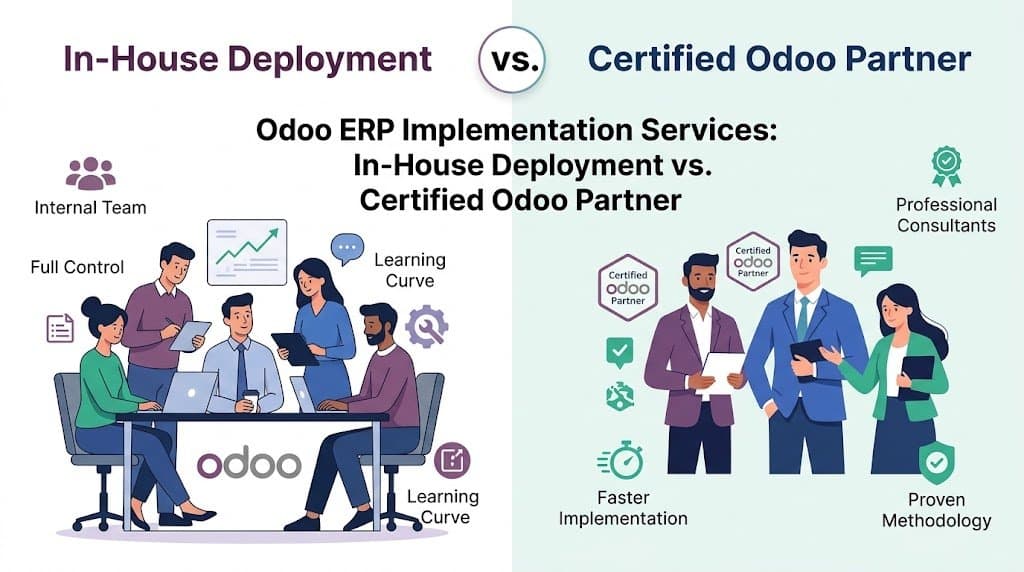
For most UAE SMEs, odoo implementation is safer, faster, and more economical when led by a certified partner rather than an internal IT team learning the platform during a live transformation. In-house deployment can work in limited cases, but once accounting, inventory, CRM, payroll, integrations, and UAE localization are involved, the apparent savings are often erased by rework, delays, and upgrade problems.
An implementation is not just installing apps. It is the structured design of business processes, data models, permissions, reports, taxes, integrations, and go-live controls so sales, purchasing, stock, finance, HR, and service operations run from one database without creating downstream reconciliation issues.
Why UAE businesses compare in-house and partner-led Odoo implementation
Decision-makers in Dubai, Abu Dhabi, Sharjah, and the wider UAE usually compare these two paths for one reason: Odoo looks modular and accessible at the start. A company can activate Sales, Inventory, or Accounting quickly, so an internal team may assume the full project is an IT configuration exercise. The comparison changes once operational dependencies appear between warehouses, valuation, invoicing, taxes, approvals, branch structures, and historical data migration.
A useful working definition is this: Odoo implementation is the end-to-end design, configuration, localization, integration, testing, migration, training, and support required to run business operations reliably on Odoo. That matters because poor early decisions in chart of accounts design, stock routes, user roles, or CRM stages do not stay isolated; they shape every transaction posted afterward.
Two buyer questions come up early. Is it better to implement internally or hire a partner? If your scope includes multiple departments, compliance-sensitive finance, or custom workflows, partner-led delivery usually reduces execution risk. Why does the choice matter so much in the UAE? Because localization is not cosmetic: VAT treatment, payroll handling, invoice formats, approval controls, and Arabic or multi-branch requirements often sit inside core transaction flows.
The real comparison is not license cost versus consulting cost. It is governance, delivery speed, business disruption, upgradeability, and whether the system can support the company for the next version cycle instead of becoming a difficult custom-built environment after year one.
What a full Odoo implementation actually includes
Senior buyers should evaluate scope before comparing vendors or internal options. A proper project begins with process discovery: how quotations become sales orders, how demand becomes procurement, how receipts become stock availability, how work orders or projects consume materials, and how every commercial event reaches accounting. That is why Full Cycle Odoo Implementation is a more accurate term than simple setup.
Core workstreams usually include module architecture, master data cleansing, role-based access, document numbering, workflow approvals, and reporting design. In a trading or van sales operation, for example, route inventory, returns, branch replenishment, and receivable collection rules must be designed before mobile users transact. In optical retail, prescription details, appointments, lens and frame stock, and multi-store customer history create a very different data model than a generic retail deployment.
Technical scope also matters. A serious deployment may require API integrations with e-commerce, payment gateways, biometric attendance devices, legacy ERPs, warehouses, or field service tools. Businesses exploring Odoo Van Sales ERP or Odoo ERP for Optical Stores Chains are not buying modules in isolation; they are buying a transaction architecture tailored to an operating model.
Go-live preparation is its own discipline: cutover sequencing, opening balances, stock validation, UAT scripts, user training by role, and hypercare after launch. Teams that skip these steps often discover too late that the software works technically but the business cannot transact cleanly on day one.
Where in-house deployment can work, and where it usually breaks down
There are valid reasons to consider an internal rollout. A company with a mature enterprise applications team, strong process ownership, light customization needs, and enough spare capacity may prefer direct control over configuration decisions. Internal teams also know company-specific exceptions, approval politics, and legacy data quirks better than any external consultant at the start.
That advantage narrows quickly when the project extends beyond a contained scope. An in-house team may manage a small CRM or service pilot, but the difficulty rises when Accounting, Inventory, manufacturing flows, payroll, branch transfers, or third-party integrations must be harmonized. According to Panorama Consulting Group, ERP projects led by certified implementation partners achieve a 57% higher rate of operational process alignment than self-managed deployments.
The hidden cost problem
What are the hidden costs of using internal IT for Odoo? They usually appear as opportunity cost rather than line-item project fees: delayed strategic projects, prolonged user workarounds, repeated testing cycles, consultant firefighting after go-live, and custom code that must later be rewritten. The total cost of ownership illusion is common; what looked cheaper at kickoff becomes expensive after six months of troubleshooting and postponed launch dates.
What is the typical timeline difference? There is no universal number because scope drives effort, but partner-led projects usually compress discovery-to-go-live time because architecture patterns, migration methods, and issue escalation paths already exist. Internal teams often spend the same period learning platform behavior that experienced implementers have seen repeatedly across industries.
Why in-house Odoo implementation fails in the UAE more often than expected
The most frequent breakdown point is localization. UAE companies do not just need a generic accounting system; they need taxes, invoice behavior, payroll controls, and reporting structures that fit actual regulatory and operating requirements. Internal teams often configure taxes at transaction level without fully designing fiscal positions, branch-level posting behavior, or ledger mappings, which later creates reconciliation problems and reporting inconsistencies.
How does a certified partner handle UAE-specific localization differently? A qualified team approaches VAT logic, payroll structure, and invoice output as part of the core architecture, not as patchwork after setup. That includes alignment with Federal Tax Authority expectations, payroll workflows that respect WPS handling requirements, and e-invoicing or document formatting rules that fit how the business issues commercial documents.
The second failure pattern is customization without upgrade discipline. Odoo is extensible, but direct source-code edits, weak module separation, and undocumented custom logic can break future version upgrades. If our in-house developers customize Odoo, will it prevent upgrades? Not always, but poor customization practice commonly creates an upgrade trap in which moving to a newer version requires code refactoring, data remapping, and retesting of every dependency.
Data migration is another underappreciated risk. Importing customers and products is simple; migrating stock positions, serial numbers, open payables, receivables, projects, service contracts, or historical prescriptions is not. Teams dealing with a failed first attempt often need structured remediation, which is why ERP re-implementation and controlled migration planning are increasingly relevant for UAE businesses that started informally and now need auditability.
What a certified Odoo partner adds: architecture, support, and long-term ROI
A certified partner brings methods, platform depth, and escalation access that an internal generalist team usually does not have. That means cleaner module dependency planning, better-fit workflow design, tested migration routines, and support pathways for bugs or version issues. It also means the business is not diverting key IT staff away from cybersecurity, infrastructure, analytics, or customer-facing initiatives just to keep an ERP project moving.
For UAE firms, the strongest benefit is often operational alignment rather than simple speed. A partner can map industry-specific flows such as job costing for contractors, batch and warehouse controls for distributors, multi-branch retail returns, or service-call billing for maintenance companies. Buyers needing post-launch resilience should also evaluate support maturity, including hypercare and steady-state optimization, not only implementation day rates; that is where post-go-live operations strategy and support design matter.
| Evaluation area | In-house deployment | Certified Odoo partner |
|---|---|---|
| Process design | Strong if internal team already knows ERP architecture | Usually stronger due to cross-industry implementation patterns |
| UAE localization | Higher risk of configuration gaps | Better fit for VAT, payroll, document, and compliance handling |
| Customization discipline | May drift into hard-to-upgrade code | Typically more modular and version-aware |
| Go-live speed | Often slower due to learning curve and competing priorities | Usually faster because delivery framework already exists |
| Support after launch | Depends on internal capacity | Structured support and escalation options |
| Total cost over time | Can rise through rework and delayed benefits | Higher upfront services cost, often lower long-term disruption |
For businesses evaluating a partner, the practical checklist is straightforward: ask how they handle configuration versus customization, how they preserve upgrade paths, how they approach data migration, which UAE localization elements they implement directly, and how support is structured after go-live. Codex positions well in this model because its work is tied to real operational scenarios, from service teams using field service and AMC workflows to broader ERP rollouts across sales, stock, finance, and service.
Which model fits your business, and why many UAE SMEs act now
The best delivery model depends on scope, internal capability, and business criticality. In-house implementation may fit a smaller company piloting limited modules with low compliance exposure and a technically strong applications team. A certified Odoo partner is usually the better choice for companies with 20 to 500 employees, multiple functions, several branches, regulated finance, or industry-specific processes that must work correctly from the first live cycle.
Construction and contracting firms typically need project cost capture, procurement controls, subcontractor coordination, and finance integration. Trading and distribution businesses need warehouse accuracy, route sales, purchasing, receivables, and branch replenishment logic. Optical chains and service-oriented SMEs have their own specialist requirements, which is why decision-makers should compare implementation capability by industry workflow, not by generic ERP sales messaging alone.
How do we transition from an unsuccessful self-implemented setup to a partner-supported model without losing historical data? Start with a technical audit of custom modules, master data quality, posting integrity, and unused configurations. Then decide whether the right approach is remediation in place, phased re-implementation, or a clean migration with validated balances and archived history; guidance on error-free data migration becomes especially important at this stage.
Why act now? Because every month spent running parallel spreadsheets, duplicate data entry, or unstable custom logic increases clean-up cost later. If your team is already discussing branch visibility, stock discrepancies, delayed reporting, or upgrade hesitation, you are no longer deciding whether to formalize the ERP program; you are deciding how much operational drag to carry before doing it properly with an experienced Codex implementation team.
Related Articles
- Odoo Erp Implementation Services Strategies For Smooth Post Go Live Operations
- Odoo Erp Implementation Services What Optical Businesses Must Ask Before Choosing An Erp
- Top 5 Erp Implementation Services For Business Growth
- How To Choose The Right Odoo Implementation Partner In Dubai
- Best Practices For Error Free Data Migration With Odoo Implementation Services
- 5 Reasons Odoo Implementation Services Drive Business Growth
Odoo Implementation: In-House vs Certified Partner
Compare Odoo implementation in-house vs a certified UAE partner for cost, speed, compliance, upgrades, and long-term ROI.
Planning AMC or field service operations? See how Codex connects service contracts, technician visits, renewals, spare parts, and invoicing in one Odoo workflow. Explore Field Service and AMC Management Software or talk to Codex for a guided consultation.
Frequently Asked Questions
Is it better to implement Odoo in-house or hire a certified Odoo partner?

How much does Odoo implementation cost in Dubai and the UAE?
What are the risks of managing Odoo implementation internally?
When does a business need Odoo customization during implementation?
How do I choose the right Odoo implementation partner in the UAE?
Can a partner recover a failed or partially deployed Odoo project?