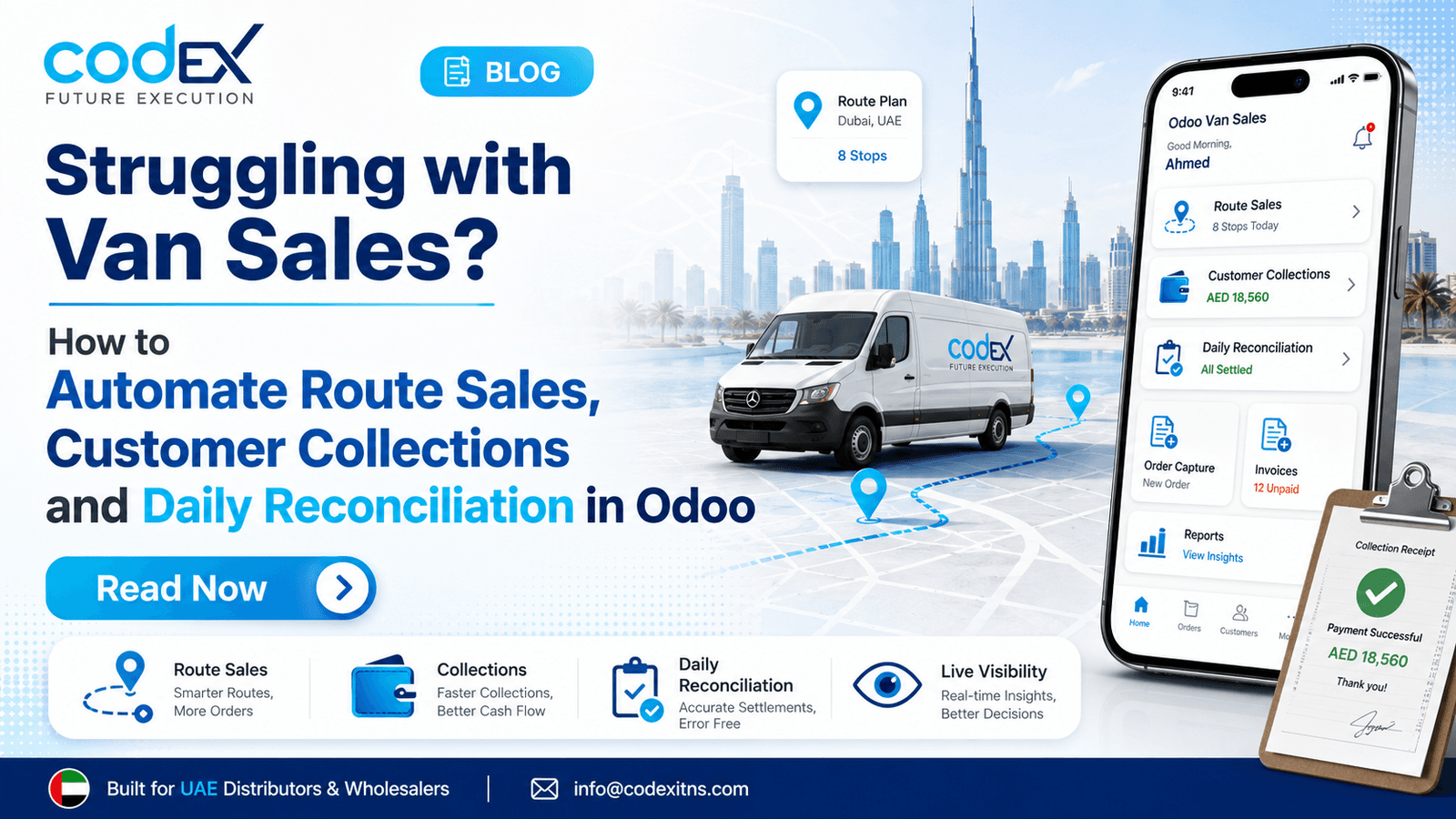
Struggling with Van Sales? How to Automate Route Sales, Customer Collections and Daily Reconciliation in Odoo
 General
Struggling with Van Sales? How to Automate Route Sales, Customer Collections and Daily Reconciliation in Odoo with Route Sales Software Dubai
Route sales software Dubai buyers usually need one thing above all: operational control over stock, invoices, collections and reconciliation while vans are on the road. In Odoo, that control comes from linking inventory, mobile sales, accounting and customer records in one workflow so each route transaction updates the business system instead of creating another paper trail to fix later.
For FMCG distributors, wholesalers and direct-store-delivery teams, van sales are rarely just a sales problem. They are a warehouse, finance and compliance problem. The right system should let a business load stock into a van, sell and invoice on the spot, collect payments, return unsold items, and close the route with clean stock and accounting records.
In practical terms, route sales software is a mobile operational layer for field distribution. It manages van inventory, route execution, customer deliveries, collections and end-of-day reconciliation inside the ERP instead of outside it.
Why van sales operations break down without route automation
Most route businesses lose control because the process is fragmented. A warehouse loads the van in one system or spreadsheet, the driver sells from paper invoices or a disconnected app, collections are noted separately, and finance tries to reconstruct the day after the vehicle returns.
That structure creates four predictable failures. First, stock in the van stops matching stock in the ERP. Second, invoice timing slips, so customers receive documents late or with errors. Third, collections become difficult to audit across cash, cards and bank transfers. Fourth, route profitability becomes guesswork because transport, sales and payment data sit in different places.
For UAE operators, VAT adds another layer of risk. A field sale still needs compliant invoice data, clear tax treatment and traceable records aligned with Federal Tax Authority requirements. When billing happens on paper and re-entry happens later, every manual touchpoint increases the chance of pricing, tax or customer-account mistakes.
Senior managers feel the impact in very concrete ways: dispatch teams spend mornings checking prior-day discrepancies, finance teams spend evenings reconciling route sheets, and sales supervisors cannot tell whether a shortfall came from stock variance, delayed posting or a collection issue. This is why many trading firms evaluating Odoo trading and distribution solutions start with route control rather than broader ERP ambition.
What route sales software should manage in a modern distribution business
A serious mobile van sales system should control the entire route lifecycle, from pre-loading to post-route settlement, while preserving one version of truth for operations and finance.
Core functions buyers should evaluate
- Van stock loading and unloading: transfer stock from the main warehouse into a route vehicle with batch, quantity and valuation visibility.
- Customer master and route planning: assign visits, delivery sequences, pricing, credit rules and sales territories.
- On-route selling: create spot sales, deliveries, returns and invoices from a mobile interface.
- Collection handling: record cash, card, transfer or mixed-mode payment against invoices or open balances.
- Returns and damages: bring back unsold, expired or damaged goods with clear stock movements.
- Route closeout: reconcile van stock, invoices, collections and outstanding receivables at day end.
The stronger platforms connect these functions to accounting and inventory without duplicate entry. Odoo is especially relevant here because its inventory, POS and accounting modules are designed to work together, and its POS stack supports connected and offline-capable retail-style workflows according to Odoo documentation.
| Evaluation area | Manual or disconnected setup | Integrated Odoo workflow |
|---|---|---|
| Van stock visibility | Updated after return or by spreadsheet | Tracked as warehouse transfers and route movements |
| Field invoicing | Paper notes re-entered later | Immediate invoice or POS transaction from mobile workflow |
| Collections | Cash sheet matched manually | Posted against customer accounts and payment methods |
| VAT handling | Risk of delayed or incorrect tax entry | Applied from configured tax rules at transaction time |
| End-of-day close | Finance reconstructs route data | System compares stock, sales, returns and payments |
How Odoo automates van loading, route sales and customer deliveries
The technical workflow begins with treating each vehicle or route as an internal stock location. The central warehouse issues an internal transfer to that location, creating a controlled handover of saleable inventory before the route starts. This ensures van stock is a tracked inventory position with quantities, products and valuation visible to operations.
What is the technical workflow for transferring stock from the main warehouse to a virtual van warehouse in Odoo? Codex configures each vehicle as an internal stock location, defines transfer rules, assigns products to the route load, validates the move, and allows route users to sell from that location during the day. Unsold items, customer returns and damaged stock move back through explicit return transfers rather than ad hoc adjustments.
For field execution, the mobile user needs fast screens, minimal clicks and customer-specific pricing. Depending on the route model, Odoo supports pre-sold deliveries, spot invoicing, direct cash sales, or a hybrid setup that combines delivery confirmation with immediate payment capture. Where Bluetooth printing is required, drivers can issue receipts or invoices at the point of transaction using compatible mobile printers.
How does Odoo manage real-time inventory tracking when connectivity is intermittent? Odoo POS supports offline operation for relevant workflows, but a serious deployment still needs implementation decisions around which transactions can continue offline, when synchronization must happen, and how route supervisors handle conflicts once the device reconnects. This is where Odoo van sales ERP design matters more than generic app features.
Managing cash, credit sales and customer collections in real time
Cash leakage in route operations usually comes from small mismatches: a receipt issued without a posted payment, a collection recorded against the wrong invoice, a partial payment not reflected in aging, or cash received but not tied to route closeout. That is why delivery and collection software must be tightly linked to receivables, not treated as a side process.
Can Odoo handle multi-currency collections and immediate cash-to-bank reconciliation for daily route sales? It can, provided the accounting model, journals, payment methods and exchange treatment are configured correctly. In practice, route teams usually collect in one dominant operating currency, but businesses serving mixed customer bases may also need foreign-currency invoices, customer-specific payment terms and clear posting rules for cash, card and transfer receipts.
A technically sound setup should support these scenarios:
- Cash sale: stock leaves the van, invoice or POS document is created, cash is posted to the route cash journal.
- Credit sale: delivery is completed, invoice is posted to the customer account, aging updates immediately.
- Collection on old balance: driver collects against one or more open invoices and records payment with reference.
- Mixed payment: part cash, part card, or partial settlement with balance remaining open.
For UAE businesses, local compliance is not optional. Tax mapping, invoice sequence rules, customer details and posted payment entries must all align with the company’s accounting and VAT configuration. Businesses exploring broader business management software transformation often discover that the real improvement is not just faster selling in the field, but cleaner receivables and fewer disputes over what was delivered, billed and collected.
How daily reconciliation works for stock, cash and outstanding invoices
End-of-day reconciliation is where many route projects prove their value. If supervisors still need three spreadsheets, a calculator and a stack of signed delivery notes to close a van, the business has not actually automated route sales. The objective is a route settlement process that compares opening stock, loaded stock, sold stock, returns, damages, cash received and receivables created in one review cycle.
Reducing reconciliation stress depends on live inventory sync and disciplined route-close procedures. In Odoo, the route can be closed against expected quantities and transaction totals, while exceptions are isolated instead of buried. A driver short on one SKU, a customer return not posted, or a payment mismatch should appear as a specific discrepancy to investigate, not a general mystery at month end.
What a strong route close should answer
- Which items were loaded, sold, returned and brought back?
- Which invoices were paid immediately, partially paid or left on credit?
- How much cash should the driver hand over by payment method and journal?
- Which customers now have updated outstanding balances?
- Which discrepancies require approval, write-off or stock adjustment?
Implementation discipline matters here. Businesses need barcode rules, payment-method controls, route permissions and a clear exception workflow for shortages, overages and damaged goods. That is why route projects should be tied to a structured Odoo van sales process and delivered through Codex style implementation work that covers inventory, accounting, mobile execution and integration together.
Implementation considerations, business fit and why many distributors should act now
Is Odoo suitable for FMCG, distribution and wholesale van sales businesses? Yes, especially where the company needs one platform for stock, route execution, pricing, invoicing and collections rather than a standalone driver app. It is less about buying software features and more about matching route logic to actual operating realities: pre-order versus spot sale, cash-heavy versus credit-heavy routes, single depot versus multi-branch distribution, and standard pricing versus customer-specific contracts.
The main buying criteria are practical. Review mobile usability, offline behavior, stock-location design, returns workflow, payment capture, VAT setup, branch visibility, integration with handheld printers or payment devices, and the quality of implementation support. Also examine whether the partner can handle custom workflow extensions, because route businesses often need tailored controls around approvals, route assignment, promotional pricing or settlement reports. That is where implementation services and customization capability become core buying factors.
Why act now? Because route complexity compounds quickly as product lines, payment channels and customer expectations grow. Every additional van, warehouse, route or branch increases the cost of running on disconnected processes. Businesses that wait usually end up hiring more people just to reconcile operational noise that the ERP should have prevented in the first place.
If your team is still managing route stock, customer collections and daily settlements through paper forms or disconnected apps, the next step is to map the actual route workflow before selecting screens and features. Codex can help you design an Odoo-based model that fits your warehouse structure, field sales process and finance controls, then implement it in a way the business can use every day.
Related Articles
- Complete Guide To Van Sales And Route Distribution With Odoo
- Odoo Van Sales Erp
- Trading Manufacturing Van Sales Solution
- Manufacturing Erp Software Dubai For Small And Medium Businesses
- Business Management Software Dubai 7 Ways To Transform Operations
- Manufacturing Erp Software Dubai 7 Key Benefits For Growth
Route Sales Software Dubai | Automate Van Sales
Route sales software Dubai guide: automate van sales, collections, stock control and daily reconciliation in Odoo for distribution businesses.
Need a van sales rollout for your field team? Review the Codex van sales solution for route planning, mobile ordering, stock control, invoicing, payments, and daily reporting. Explore Odoo Van Sales Solution or talk to Codex for a guided consultation.
Frequently Asked Questions
What is route sales software and how does it improve van sales operations?

Can Odoo manage van inventory, customer deliveries and field collections in one system?
How does route sales software help with daily cash and stock reconciliation?
Is Odoo suitable for FMCG, distribution and wholesale van sales businesses?
Can route sales software work on mobile devices for sales drivers in the field?
How does Odoo handle spot invoicing and receipt printing during deliveries?