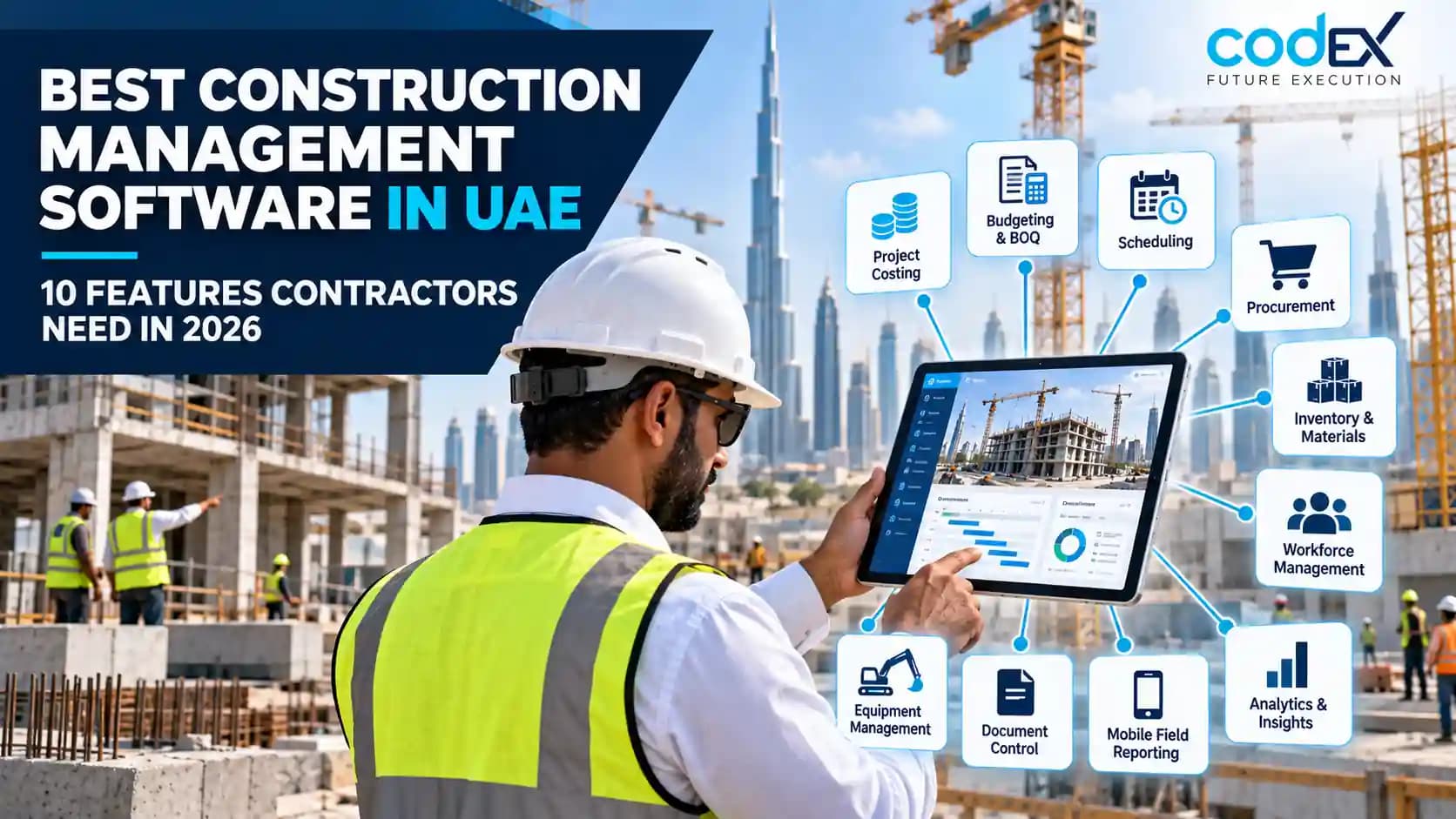
The best construction management software in UAE is no longer just a scheduling tool. Contractors now need a connected platform that handles project costing, procurement, subcontractors, billing, payroll, equipment, and finance in one environment, with workflows that match UAE tax, labor, and contracting practice.
For contractors working across Dubai, Abu Dhabi, and other emirates, the real issue is not whether software exists; it is whether the system can connect site activity to commercial and accounting control without forcing teams back into spreadsheets. That matters in a market where project complexity is rising alongside demand: according to Mordor Intelligence, the UAE construction market is estimated at USD 41 billion in 2024 and is expected to reach USD 50.40 billion by 2029.
Construction management software is a system used to plan, control, and record the commercial and operational side of projects. In practice, the stronger platforms combine BOQ-based budgeting, material requests, subcontractor claims, site reporting, IPC billing, payroll inputs, and financial posting, so management can see actual performance while the job is still running.
1. Core Cost Control Starts with Live Project and BOQ Visibility
1. Real-time actual vs budget tracking
The first requirement is continuous visibility into committed, actual, and remaining cost against the BOQ and project budget. A contractor should be able to see labor, material, equipment, and subcontractor cost posted against the relevant cost code as soon as a timesheet, vendor bill, stock issue, or claim is approved.
This is the difference between managing the job and reviewing it after margin has already slipped. When a steel package begins exceeding planned consumption or labor hours on an MEP activity trend above estimate, project managers need alerts during execution, not at month-end close. For firms evaluating Odoo Construction Project Management Software, this is usually the first area where disconnected Excel trackers are replaced with live cost reporting.
2. BOQ imports that connect estimating, procurement, and execution
Good software should import complex bills of quantities, preserve cost structure, and map each line to procurement, stock, subcontracting, and billing workflows. If the estimate sits in one file and purchasing runs in another, the team loses the ability to measure committed cost before invoices arrive.
Can construction management software handle project costing and procurement together? The answer should be yes. Material requisitions, RFQs, purchase orders, GRNs, stock issues, and supplier invoices all need to roll back to project cost codes, so buyers can compare budget, commitment, receipt, and consumption on the same screen.
2. Margin Protection Depends on Subcontractor and Billing Discipline
3. Subcontractor claims, retention, and back-to-back control
For many UAE contractors, subcontractors are where commercial leakage starts. The software should manage subcontract agreements, work certified, deductions, advances, retention, and payment terms, while preserving an auditable approval trail for every claim.
Without that structure, site teams certify quantities, accounts process invoices, and commercial managers discover overpayment later. A stronger setup ties subcontractor progress to measured work, variation approval, retention release, and outstanding liability in one place, which is exactly why many firms review Odoo Construction Subcontractor Management Software before standard ERP products.
4. Variation order and IPC billing workflows
Variation orders should move through pricing, approval, client submission, and billing without manual version confusion. The software must record the original contract value, approved changes, pending VOs, and their effect on revised budget and expected margin.
How does the system manage variation orders without manual errors? It should link each VO to the project, BOQ item or cost head, commercial approval, and customer billing stage. The same platform should also support interim payment certificates and milestone-based invoicing, while producing VAT-compliant invoices aligned with Federal Tax Authority requirements rather than leaving finance to rebuild figures separately.
3. Site Operations Need to Feed Payroll, Assets, and Financial Posting
5. Labor timesheets that drive WPS-ready payroll inputs
In the UAE, payroll is not a peripheral HR task for contractors; it is operational data. Site attendance, daily timesheets, overtime, and allocation by project or cost code should feed payroll preparation so accounts and HR are not re-entering labor data from WhatsApp sheets and handwritten logs.
Is the ERP fully compliant with UAE payroll practice? The right platform should support WPS-oriented payroll processing, allowances, deductions, and traceable payroll records, while aligning with UAE labor obligations. For contractors with large site teams, that means labor cost can hit the project ledger accurately instead of being journaled in bulk after payroll is closed.
6. Plant, machinery, and equipment allocation by site
Contractors also need visibility into where assets are deployed, how long they are used, and what they cost the project. Cranes, generators, vehicles, scaffolding sets, and rented equipment should be assignable to active jobs with utilization, maintenance, and transfer history available to both operations and finance.
Can the software track plant and machinery across multiple active sites in Dubai and Abu Dhabi? It should, and it should do more than show location. A practical setup records ownership or rental basis, internal charge-out, downtime, service schedules, and the cost impact of moving assets between projects. That is the operational value behind Odoo Construction Equipment Asset Management.
4. Construction Software Must Control Documents and Regional Complexity
7. RFIs, submittals, transmittals, and daily site records
Generic task boards do not solve construction communication. Contractors need formal workflows for RFIs, technical submittals, material approvals, drawing revisions, transmittals, site instructions, and daily progress reports, each tied back to the project and, where relevant, to cost and procurement impact.
This matters because delays are often caused less by scheduling logic than by missing approvals and untracked design clarifications. A strong system lets teams record a site issue, attach the supporting document trail, assign a responsible party, and see whether the issue affects procurement lead time, subcontractor execution, or billing entitlement. That is why the best construction management software in UAE increasingly looks more like construction ERP than isolated PM software.
8. Multi-company, multi-currency, and regional procurement support
Many UAE contractors buy locally, source specialist material internationally, and operate across multiple legal entities or branches. The software should support different companies, warehouses, projects, currencies, tax treatment, and approval matrices without forcing separate databases for each operating unit.
For example, a contractor may procure HVAC equipment in USD, issue local service contracts in AED, and transfer material between central and site stores. The system should track landed cost, vendor commitments, and branch-level accountability while still producing consolidated reporting for leadership. Codex has covered this broader construction ERP angle in its article on construction ERP in UAE, especially where project delivery depends on integrated purchasing and finance.
5. The Best Fit Combines Construction Depth, ERP Control, and a UAE Implementation Partner
9. Construction finance integrated with VAT, IPC, and cash flow
The finance layer should not sit outside the project system. Job cost accruals, retention accounting, certified revenue, supplier liabilities, customer invoicing, and VAT treatment need to flow into the general ledger directly, so finance managers do not spend month-end reconciling three different versions of the project position.
For UAE contractors, VAT-compliant invoicing is baseline, not optional. Software should support customer billing by stage or certification, supplier invoice matching, retention accounting, and cash-flow visibility by project. This is where specialized workflows such as Odoo Construction Finance Billing IPC Management become more useful than generic accounting add-ons.
10. Configurability, integrations, and local support decide long-term success
Even the strongest product fails if it cannot match your workflows. Construction firms should assess whether the platform can be configured for approval hierarchies, BOQ structures, retention logic, document numbering, branch controls, and integrations with biometric attendance, Excel imports, procurement portals, or legacy finance systems.
What is the best construction management software in UAE for contractors? Usually, it is the system that combines construction-specific process control with ERP-grade accounting and a partner that can localize the implementation. For many SMEs and mid-sized contractors, Odoo construction management software is a strong option because it can be shaped around actual operations rather than forcing a fixed global template. The implementation partner matters just as much as the platform, which is why buyers should evaluate process mapping, customization capability, training, and post-go-live support before signing.
| Evaluation area | Standalone PM tools | Generic ERP | Construction-focused ERP setup |
|---|---|---|---|
| BOQ and cost-code control | Usually limited | Possible but often generic | Built around project cost structure |
| Subcontractor claims and retention | Often manual | Partially configurable | Handled as a core workflow |
| IPC, milestone billing, VAT posting | Weak finance linkage | Strong accounting, weaker project context | Project and finance stay connected |
| Site timesheets to payroll | Separate tools required | Possible with customization | Integrated labor-cost posting |
| Plant and equipment allocation | Basic logs only | Asset-centric, not site-centric | Tracks deployment by project |
| Best fit | Small teams with light controls | Businesses needing back-office standardization | Contractors needing operational and commercial depth |
A practical shortlist should also include implementation risk. Common mistakes include digitizing old spreadsheet habits instead of redesigning workflows, excluding finance from project-system selection, underestimating master-data cleanup, and choosing a tool that cannot scale from one active job to a multi-entity portfolio. Contractors evaluating Codex typically look for a partner that can align project, procurement, payroll, and accounting under one UAE-ready architecture rather than deploying modules in isolation.
Related Articles
- Best Optical Chain Management Software Features
- Odoo Construction Subcontractor Management Software
- Construction Erp Uae Driving Project Management Efficiency In Construction Firms
- Amc Management Software Uae Odoo Guide
- Fmcg Distribution Software Uae Batch Expiry Promotion Management
- Odoo Construction Project Management Software
Best Construction Management Software in UAE 2026
Discover the best construction management software in UAE and the 10 features contractors need in 2026 for cost, site and finance control.
Related solution: Field Service and AMC Management Software explains how Codex handles this workflow for UAE businesses.
Planning AMC or field service operations? See how Codex connects service contracts, technician visits, renewals, spare parts, and invoicing in one Odoo workflow. Explore Field Service and AMC Management Software or talk to Codex for a guided consultation.
