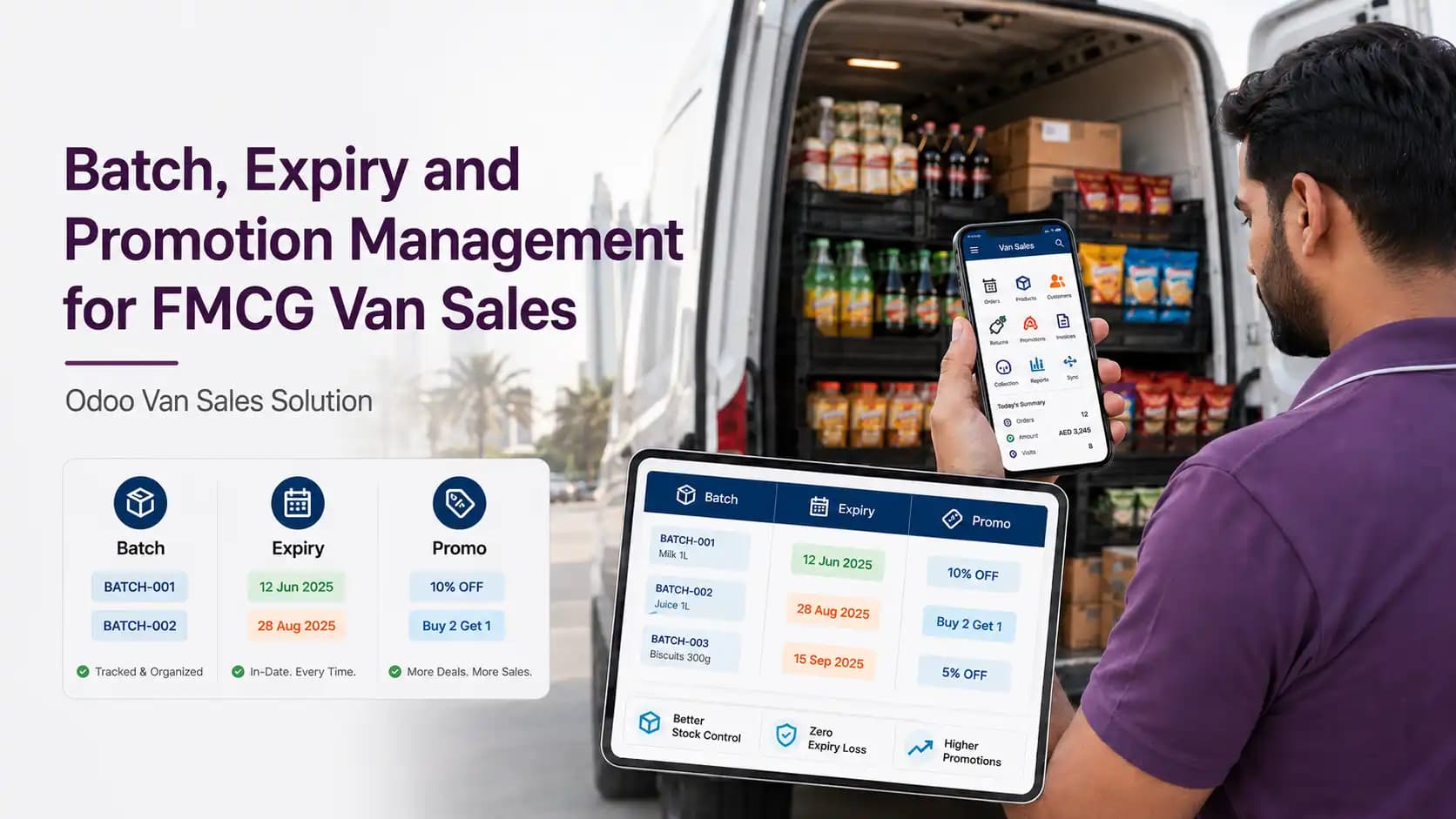
Batch, Expiry and Promotion Management for FMCG Van Sales
 General
Batch, Expiry and Promotion Management for FMCG Distribution Software UAE
FMCG distribution software UAE should do far more than record orders. For van sales operations, it must control batch numbers, expiry dates, promotions, mobile invoicing, and stock movement between warehouse and vehicle in one system. That is the difference between a route operation that protects margins and one that leaks value through expired stock, pricing errors, and manual reconciliation.
In practical terms, this category of software combines route sales mobility with ERP inventory, accounting, and tax logic. The result is a field-ready operating model where each van is treated as a controlled mobile warehouse rather than a spreadsheet-driven sales vehicle.
Why batch, expiry, and promotion control matter in FMCG van sales
Van sales in FMCG is operationally demanding because stock is not only stored in a central warehouse. It is transferred into vehicles, exposed to route-level demand changes, sold in small quantities across many outlets, and often returned partially at the end of the day. When products carry batch numbers and expiry dates, every movement must remain traceable across that chain.
This is especially important for food and beverage distribution. According to Mordor Intelligence, the UAE food and beverage market is estimated at USD 19.33 billion in 2024 and is expected to reach USD 27.81 billion by 2029, creating more pressure on distributors to manage higher route volumes without losing batch visibility. At the same time, municipal food safety oversight makes expiry discipline a frontline issue, not a back-office one; distributors operating regulated categories should align field processes with guidance from the Dubai Municipality.
Promotions add another layer of complexity. A driver or van salesperson may need to apply mix-and-match offers, free goods, carton discounts, retailer-specific schemes, or route-day promotions at the customer site. If these rules are handled manually, the business risks margin erosion, disputes, and inconsistent execution across vans.
For that reason, distributors increasingly evaluate software by asking a narrow question: can it prevent expiry mistakes, apply trade schemes correctly offline, and reconcile van stock back to ERP without delay? A purpose-built trading, manufacturing, and van sales solution must answer yes to all three.
Where manual van sales operations usually break down
The most common failure point is inventory separation. Warehouse stock may be tracked in one system while van stock is managed on paper, in Excel, or inside a disconnected mobile app. Once that happens, batch accuracy deteriorates quickly: the head office sees quantities, but not always the exact lot, age profile, or expiry risk sitting on each vehicle.
Another problem is weak offline capability. Field representatives often work in basements, industrial zones, remote sites, or retail clusters where connectivity drops. If the mobile application cannot validate promotions, enforce credit rules, and record invoices offline, users improvise. Improvisation usually means delayed entries, pricing exceptions, and stock discrepancies discovered only at route close.
Typical operational gaps
- Batch numbers captured at receipt but lost during van loading
- Near-expiry items dispatched because picking is quantity-based rather than FEFO-based
- Promotions applied differently by each salesperson
- Retailer returns handled manually, without reason codes or batch traceability
- Tax invoices printed later from the office instead of issued at point of sale
These gaps are expensive because they combine compliance exposure with margin loss. The Food and Agriculture Organization estimates that roughly 1.3 billion tons of food are lost annually worldwide; while that figure is global rather than UAE-specific, it underscores why expiry control and stock rotation are not minor warehouse topics. In a route-distribution context, poor visibility turns preventable ageing stock into write-offs, retailer claims, and avoidable returns.
Businesses planning an Odoo route distribution rollout should map these failure points before selecting screens, workflows, and approval rules. Software configuration matters, but process design matters first.
How Odoo-based software improves batch tracking across warehouse and vans
Effective batch control starts with a simple principle: the van must exist in the ERP as a stock location, not just as a sales resource. Once each vehicle is modeled as an internal location, products can be transferred from warehouse to van with recorded batch numbers, quantities, and dates. That creates a continuous inventory chain from purchase receipt to final retailer invoice.
On the warehouse side, Odoo inventory logic supports lot and serial management, stock moves, transfers, and traceability, as documented in the Odoo Inventory and MRP documentation. In a van sales deployment, those capabilities are extended through mobile workflows: load confirmation, route issue, on-van stock inquiry, batch-aware selling, returns capture, and end-of-day reconciliation. That is the practical foundation of Odoo van sales ERP.
How can you prevent drivers from selling expired or near-expiry batches? The best approach is system-level restriction, not policy memos. The mobile app should expose only eligible batches for sale based on expiry threshold rules, while warehouse loading should prioritize FEFO selection so older valid stock leaves first. If the business wants extra control, near-expiry batches can trigger warning messages, supervisor approval, or route exclusion.
How do you handle real-time inventory reconciliation between central warehouse and van stock? Treat each event as a stock transaction: load to van, sale from van, return from customer, damage write-off, and unload back to warehouse. Once those moves post to the same ERP database, finance and operations stop arguing over which stock figure is correct, because the system keeps one auditable ledger.
| Process area | Manual route operation | Integrated ERP van sales model |
|---|---|---|
| Van loading | Quantity-only issue sheets | Batch-level transfer to vehicle stock location |
| Field selling | Driver chooses items manually | Mobile app proposes valid batches and prices |
| Promotion execution | Relies on rep memory | Rule-based discounts and free goods |
| Returns | Paper notes with unclear cause | Reason-coded, batch-traceable reverse moves |
| Route close | Late reconciliation | Same-day stock and invoice posting |
Managing expiry dates, returns, and FTA-compliant invoicing
Expiry management becomes reliable only when it spans both warehouse and field stock. Many distributors already record expiry at goods receipt, but they lose control when inventory moves into vans. The right setup carries expiry metadata into every downstream transaction so the business can ask not only how much stock is on a vehicle, but which batches are approaching sell-by thresholds.
Can van sales software manage product expiry dates across multiple vehicles? Yes, if each van is configured as a tracked stock location and each movement preserves lot data. That allows dispatch teams to monitor ageing inventory by vehicle, route, product category, and remaining shelf life. It also supports smarter reallocation: a slow-moving van can unload short-dated stock back to the warehouse or to a faster route before it becomes unsellable.
Returns and damage claims should be handled at customer site in the same mobile workflow used for invoicing. A well-designed ERP process lets the representative capture quantity, batch, reason code, condition, and resale status immediately. That matters because a return is not a single event; it may become saleable stock, quarantine stock, a vendor claim, or a controlled disposal task depending on policy.
Invoicing must be immediate and tax compliant. Distributors operating in the UAE should align invoice structure, tax configuration, and recordkeeping with guidance from the Federal Tax Authority. In practice, that means the mobile app should generate the same tax-valid document logic used by the ERP, rather than letting drivers create informal receipts that accounting has to rebuild later.
Companies that have already explored Odoo inventory management often find that van sales is where traceability either matures or breaks. The technical requirement is straightforward: expiry, batch, tax, and return logic must travel with the route transaction, not remain trapped in the warehouse module.
Promotion management in the field and the features buyers should insist on
Promotion management for van sales is rarely just a discount field. FMCG distributors commonly run layered schemes by customer type, route, product family, quantity break, carton conversion, or period. Some offers also mix monetary discounts with free goods, which means the mobile application must evaluate eligibility, award the correct item, and post the cost impact back to inventory and margin reporting.
Can mobile van sales software apply complex promotions offline and sync them back to Odoo? It can, provided the rule engine is available on the device and not dependent on live API calls for every transaction. That offline-first model is important in real field conditions because salespeople still need to validate offers, check stock, enforce credit limits, and print or share invoices when connectivity is unstable.
What to look for in van sales software UAE
- Offline-first mobile order, invoice, return, and collection workflows
- Vehicle-level stock locations with batch and expiry visibility
- FEFO-aware loading and selling rules
- Promotion engine for free goods, quantity breaks, bundles, and customer-specific pricing
- Credit limit checks and outstanding balance visibility during the visit
- Route settlement, cash collection, and end-of-day reconciliation
- Integration with ERP accounting, tax, purchasing, and replenishment
The best implementations are rarely off-the-shelf in the purest sense. Distribution companies often need route-specific approvals, custom promotion logic, handheld printing, barcode support, or integration with DMS, WMS, or external ordering channels. That is where Codex differentiates through industry-focused Odoo design, implementation, and integration work rather than generic ERP deployment.
If the objective is to reduce expired returns, tighten stock control, and give management one view across warehouse, vans, collections, and invoicing, the project should be designed as an operational control system, not just a mobile sales app. A specialist partner can map those route processes into Odoo with the right mobile, accounting, and inventory architecture from the start.
Related Articles
- Complete Guide To Van Sales And Route Distribution With Odoo
- Best Optical Chain Management Software Features
- Optical Inventory Management Software Odoo
- Looking For Odoo Inventory Management Software Heres What You Need To Know
- Business Management Software Dubai 7 Ways To Transform Operations
- Odoo Van Sales Erp
FMCG Distribution Software UAE for Batch Control
See how FMCG distribution software UAE improves batch tracking, expiry control, promotions, and van sales invoicing.
Need a van sales rollout for your field team? Review the Codex van sales solution for route planning, mobile ordering, stock control, invoicing, payments, and daily reporting. Explore Odoo Van Sales Solution or talk to Codex for a guided consultation.
Frequently Asked Questions
How does FMCG distribution software help track batch numbers in van sales?

Can van sales software manage product expiry dates across multiple vehicles?
How do sales teams apply promotions correctly during field sales visits?
What are the benefits of batch and expiry control for FMCG distributors?
Can Odoo-based van sales software integrate with inventory and accounting?
What is the best way to manage product returns and damage claims at customer site?