Complete Guide to Managing AMC and Field Service in Odoo
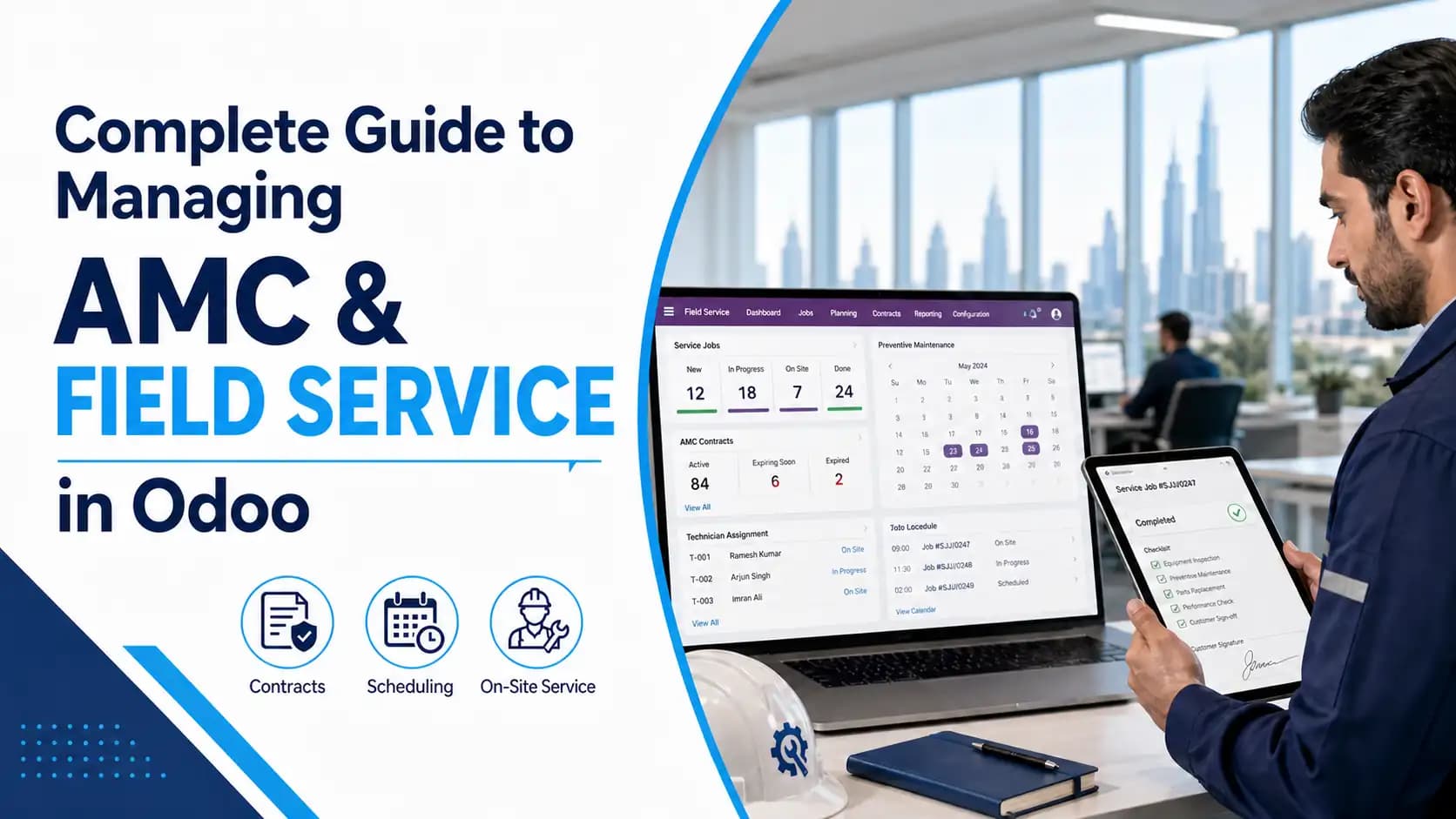 General
Complete Guide to AMC Management Software UAE with Odoo
For UAE service providers, the best AMC management software UAE buyers can implement is not a standalone contract register. It is a connected system that manages annual maintenance contracts, service calls, technician dispatch, spare-parts consumption, SLA tracking, and invoicing in one workflow. Odoo fits that requirement well because it combines contract logic, field service operations, inventory, accounting, and customer history inside a single ERP environment.
In practice, this matters most for HVAC, MEP, facility management, and technical service firms that run recurring visits under strict response commitments. When contracts sit in spreadsheets, tickets live in WhatsApp, and billing happens in accounting software later, operational leakage is almost guaranteed. A structured Odoo setup closes those gaps.
What AMC management software does for UAE service businesses
AMC management software is a system used to control recurring maintenance agreements from contract creation through service delivery and renewal. In Odoo, that usually means combining subscription or contract-style records with helpdesk, field service, inventory, timesheets, and accounting so every visit can be traced back to a customer agreement. That is a more useful definition than a generic “maintenance database” because UAE buyers usually need finance and operations to work together, not separately.
For many local firms, the operational model is predictable. A customer signs a one-year or multi-year contract, periodic preventive maintenance visits must be scheduled, emergency calls must meet agreed response times, spare parts may or may not be covered, and invoices may be raised monthly, quarterly, or by milestone. The software therefore has to manage entitlement as well as execution: what is included, when a team should go, what was consumed, and what should be billed.
This is why annual maintenance contract software in the UAE is often evaluated by operations managers and finance teams together. The operations side wants dispatch control, technician visibility, and equipment history. Finance wants clean renewal dates, VAT-compliant invoicing, contract profitability, and fewer unbilled service events. Odoo addresses both, especially when configured around the company’s actual service catalogue and SLA commitments.
For SMEs that have outgrown disconnected tools, the bigger value is standardization. Instead of each branch or supervisor running service calls differently, the business can define one process for contract activation, preventive schedules, breakdown escalation, stock issuance, service reports, approvals, and billing.
Where manual AMC and field service processes usually break down
Most UAE service businesses do not struggle because they lack effort; they struggle because the process chain is fragmented. Contracts are tracked in Excel, service requests arrive by phone or email, dispatchers update technicians in chat groups, and spare parts are deducted later if someone remembers. The result is weak visibility into which customers are covered, which visits are overdue, and which jobs should trigger extra billing.
Manual control also creates financial leakage. A technician may install a replacement component during an urgent site call, but unless that item is registered against the work order and the contract coverage rules are clear, the office may never invoice it. The same problem appears with overtime, additional visits beyond the contract limit, and chargeable corrective work attached to a preventive maintenance agreement.
Another common failure point is SLA enforcement. In the UAE, response commitments are often part of commercial competitiveness, especially for high-value commercial facilities and critical equipment. If ticket timestamps, dispatch decisions, travel status, and job completion records are not connected, managers cannot see approaching breaches early enough to escalate.
Manual tracking vs integrated Odoo workflow
| Process area | Manual setup | Integrated Odoo setup |
|---|---|---|
| Contract renewals | Reminder calendars and spreadsheets | Central renewal dates, alerts, and customer records |
| Preventive visits | Separate planning sheets by supervisor | Scheduled tasks linked to contract and site |
| Emergency calls | Phone-based allocation with limited audit trail | Ticket-to-dispatch workflow with status tracking |
| Spare parts usage | Recorded later or missed entirely | Consumption logged against task and inventory |
| Invoicing | Raised after manual reconciliation | Automated billing from contract rules or milestones |
| Customer history | Scattered across emails and paper reports | Site, asset, visit, and signature history in one record |
That shift is why many firms start looking at field service management software UAE teams can use on-site rather than another office-only admin tool. The operational bottleneck is usually in the handoff between dispatch, technician execution, and finance reconciliation.
How Odoo manages contracts, renewals, and service SLAs
Odoo can manage AMC structures by linking customer agreements to recurring tasks, service entitlements, invoicing rules, and helpdesk or field service activity. The key design choice is not simply “turning on a module”; it is deciding how each contract should behave. A preventive maintenance agreement for quarterly visits is configured differently from a comprehensive contract that includes unlimited callouts, response categories, and separate charge-back logic for excluded materials.
Buyers often ask: How does Odoo manage auto-renewal alerts and indexation for multi-year AMC contracts in the UAE? The practical answer is through contract metadata, scheduled activities, recurring billing logic, and custom fields where required. Renewal alerts can be triggered ahead of expiry for sales or account managers, while price revision rules, escalation percentages, or index-linked commercial terms can be implemented through customization so the renewed contract reflects the agreed pricing policy instead of a generic flat renewal.
SLA control works best when contract terms and service tickets are connected. Priority, covered response window, promised visit timing, escalation path, and customer category can be inherited from the contract or service level matrix. That allows the system to highlight delayed tickets, notify supervisors, and separate a standard service request from a critical facility issue that needs immediate attention.
What should be defined at contract level
- Contract period, notice period, and renewal lead time
- Covered sites, equipment, or service assets
- Included preventive visits and callout limits
- Response and resolution targets by severity
- Billing frequency, milestone rules, and exclusions
- Whether parts, labor, travel, or subcontractor costs are covered
When those rules are configured correctly, Odoo becomes service contract management software UAE teams can actually govern with, rather than a digital filing cabinet. For businesses planning a broader rollout, that contract design is usually part of the initial Odoo ERP implementation services from Codex.
Managing field service operations in Odoo: scheduling, dispatch, and technician execution
The field side of AMC delivery depends on timing, route decisions, and the quality of information available to technicians before they arrive on-site. Odoo’s field service workflow can assign jobs by technician, territory, skill set, or equipment type, then push those tasks to mobile users with addresses, service instructions, asset history, and required materials. For Dubai and other high-density service areas, planning logic matters because technician utilization can collapse when travel is ignored during scheduling.
Buyers also ask: Can field technicians update inventory consumption and request spare parts directly from the Odoo mobile app while offline? In a well-designed deployment, they can capture job notes, timesheets, photos, signatures, and stock usage in the field, with synchronization when connectivity returns. That is especially important for basement plant rooms, remote compounds, construction environments, and extreme summer conditions where technicians cannot depend on perfect mobile coverage for every update.
Another frequent question is: How does Odoo handle SLA tracking and escalate delayed service tickets? The answer is through status timestamps, priority rules, and manager alerts tied to the underlying helpdesk or service workflow. Dispatchers can monitor open jobs, overdue calls, and technician workload in one queue rather than piecing together status from calls and chats. For critical accounts, escalation stages can be configured so an approaching breach is visible before the customer complains.
This is also where route optimization and resource planning start to matter commercially. A dispatch board that shows technician availability, job duration, location clusters, and pending callouts helps service managers reduce idle travel and fit preventive visits around urgent work. Many UAE firms initially buy Odoo for contract control, then discover that better scheduling has an equal effect on margin protection.
Billing, inventory control, and service reporting inside one Odoo workflow
Finance teams usually judge an AMC platform by one question: does the system convert service activity into billable, auditable transactions without manual rework? Odoo can do this by linking contracts, work orders, delivered services, stock moves, and accounting entries. When configured properly, a quarterly contract invoice, a milestone invoice after a defined service event, or a chargeable extra visit can all be produced from the same operational record.
Is it possible to generate automated VAT-compliant invoices in Odoo based on AMC milestone achievements? Yes, provided the milestone structure, taxable items, and customer terms are defined correctly during implementation. That allows finance teams to bill on completion of scheduled maintenance cycles, phase-based service commitments, or recurring periods while preserving a clear audit trail from contract to invoice.
The inventory side is where many service providers recover margin. Every filter, relay, motor, or consumable issued to a technician should move through stock, be linked to the customer task, and be evaluated against contract coverage rules. This is the financial leakage cure: if a spare part is outside contract scope, the system should support direct charge-back; if it is included, the cost should still be visible for profitability analysis.
Service records that should be captured on every visit
- Arrival and completion time
- Equipment or asset serviced
- Work performed and checklist completion
- Parts consumed and quantities used
- Photos, observations, and safety notes
- Customer approval or digital signature
That level of traceability is why companies often combine Odoo with tailored workflows, customer-specific forms, and third-party connections such as telephony, map tools, or legacy asset systems. Those requirements usually sit within Odoo customization and integration work delivered by Codex, not in a default installation.
Which UAE industries benefit most and what to plan before implementation
The strongest fit is in businesses where recurring service, field execution, and periodic billing are tightly linked. HVAC and MEP contractors need preventive maintenance planning, breakdown tracking, and material control. Facility management providers need SLA governance across multiple sites and customer categories. IT infrastructure service companies need asset history, engineer dispatch, and contract renewals. Elevator, fire safety, water treatment, and specialized equipment maintenance companies have similar requirements.
Construction-related service operations also benefit when post-handover maintenance contracts must be tracked by project, building, or developer account. Multi-branch service businesses in Dubai, Abu Dhabi, and Sharjah often need separate teams, stock locations, and profit visibility by region. In each case, the buyer should assess whether the software can model site hierarchies, installed equipment, technician skills, and covered versus excluded service items.
Implementation planning should be practical, not theoretical. Before rollout, define how contracts are priced, how PM schedules are generated, who approves extra work, how stock is issued to vans or technicians, and how invoices are triggered. Data cleanup is equally important: customer sites, installed assets, active contracts, service frequencies, and item masters need to be structured before migration.
Finally, UAE companies should evaluate the partner, not only the platform. The right team will map workflows, design approval logic, localize accounting and VAT treatment, and support post-go-live changes as real service exceptions appear. Businesses that need an ERP foundation beyond service operations can start that journey through Codex, then expand into accounting, purchasing, HR, CRM, and wider operational reporting without changing systems later.
Related Articles
- Mahesh
- Odoo Van Sales Erp
- Complete Guide To Van Sales And Route Distribution With Odoo
- Optical Erp Implementation Uae Checklist
- Best Optical Chain Management Software Features
- Optical Inventory Management Software Odoo
AMC Management Software UAE Guide to Odoo
Learn how AMC management software UAE works in Odoo for contracts, SLA tracking, field service, billing, inventory, and renewals.
Related solution: Field Service and AMC Management Software explains how Codex handles this workflow for UAE businesses.
Planning AMC or field service operations? See how Codex connects service contracts, technician visits, renewals, spare parts, and invoicing in one Odoo workflow. Explore Field Service and AMC Management Software or talk to Codex for a guided consultation.
Frequently Asked Questions
What is AMC management software and how does it work?

Can Odoo manage annual maintenance contracts and field service together?
How can UAE companies automate technician scheduling and service visits?
Does Odoo support AMC invoicing, renewals, and service history tracking?
Why choose an Odoo implementation partner in the UAE for AMC management?
Can Odoo support predictive maintenance as well as reactive callouts?