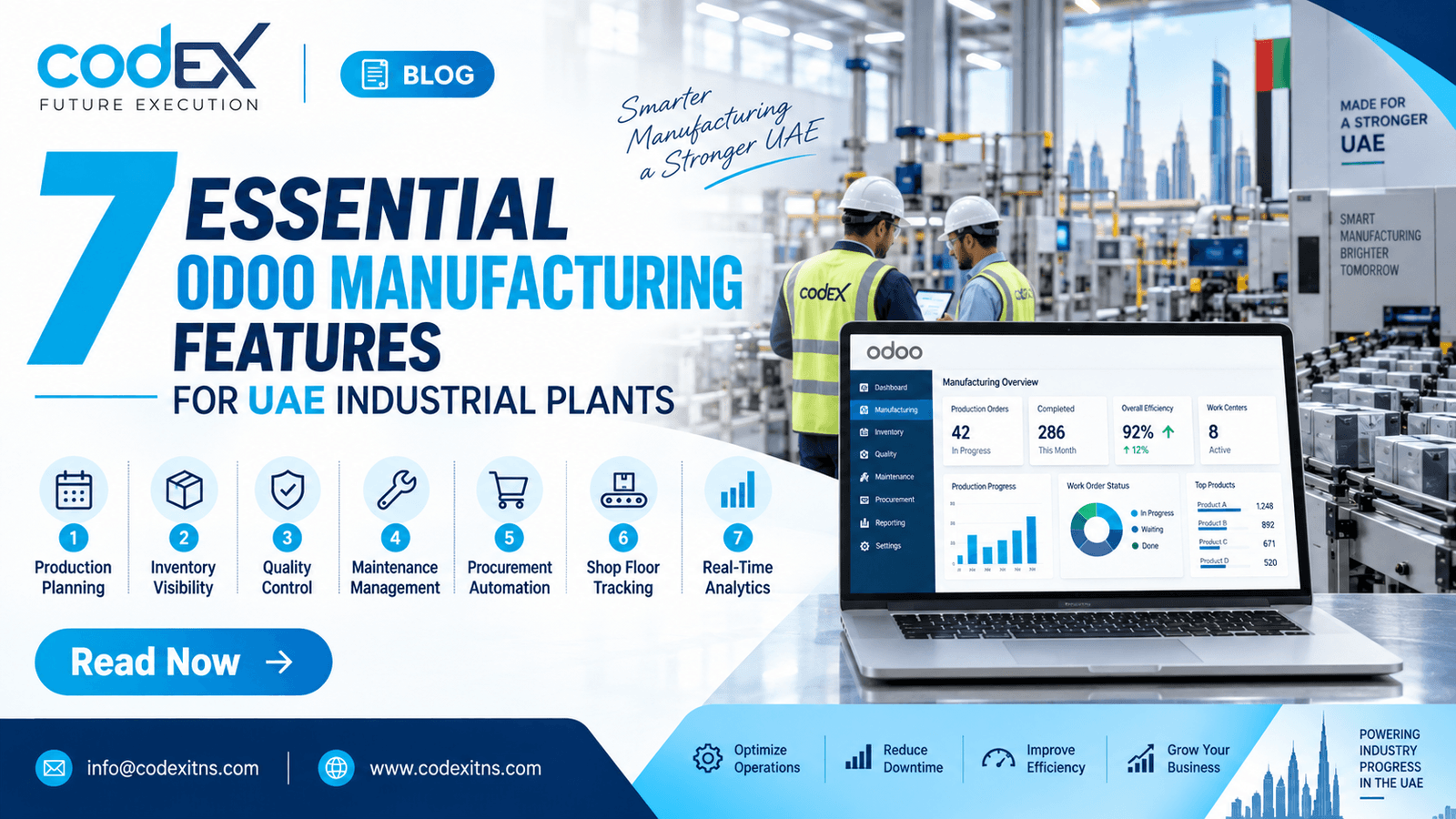
7 Essential Odoo Manufacturing Features for UAE Industrial Plants
 General
Odoo manufacturing gives UAE factories a practical way to control production, materials, quality, maintenance, and costing inside one connected system. For industrial plants in Dubai, Abu Dhabi, Sharjah, and the wider UAE, the most valuable features are the ones that solve real shop-floor problems: multi-level BoMs, live work orders, capacity planning, stock accuracy, traceability, machine uptime, and financial visibility.
In simple terms, Odoo Manufacturing is the MRP layer within Odoo ERP that manages bills of materials, routing, work centers, production orders, quality points, maintenance, inventory movements, and production costs in one workflow. That matters in the UAE because manufacturers often operate across free zones, import raw materials in multiple currencies, and need stronger control over compliance, subcontracting, and delivery reliability.
Why UAE plants need tighter manufacturing control
Manufacturing businesses in JAFZA, KIZAD, HFZA, and other industrial zones rarely struggle because they lack activity; they struggle because planning, inventory, procurement, and costing live in separate tools. Once purchase teams track imports in spreadsheets, warehouse teams update stock later, and finance closes costs after the fact, production managers are left making decisions with delayed data.
The pressure is rising. According to UAE Ministry of Industry and Advanced Technology, the Operation 300bn strategy targets AED 300 billion in industrial contribution by 2031. For local plants, that makes operational discipline more than an internal efficiency project; it becomes part of competing on responsiveness, localization, and reporting maturity.
Buyers evaluating Odoo ERP for manufacturing companies usually ask the same direct questions. Can the system handle nested BoMs for assembled products? Can it track labor and machine time by work center? Can it support multi-warehouse operations between a Dubai plant and an Abu Dhabi distribution hub? The answer is yes, but only when the implementation is designed around the actual plant workflow rather than generic ERP screens.
| Plant requirement | Odoo manufacturing capability | UAE relevance |
|---|---|---|
| Complex product structures | Multi-level BoMs and routing | Supports engineered assemblies and staged production |
| Shop-floor control | Work orders and work centers | Tracks labor, capacity, and machine usage |
| Imported raw materials | Inventory, purchasing, and replenishment integration | Improves visibility across ports, free zones, and warehouses |
| Compliance and customer quality demands | Quality points, checks, lots, and serial traceability | Useful for regulated and audit-heavy environments |
| Downtime reduction | Preventive and corrective maintenance | Helps protect uptime where machine hours are expensive |
1-2. BoM accuracy and shop-floor execution
1. Multi-level Bills of Materials keep production accurate from the first issue of stock
A strong BoM structure prevents waste, shortages, and miscosted output before a work order even starts. Odoo supports multi-level bills of materials, variants, by-products, and operation-linked components, which is critical for plants producing finished goods with subassemblies, packaging layers, or alternate material options.
For a Dubai-based industrial manufacturer assembling panels, for example, one finished unit may depend on several subassemblies, each with its own routing, consumables, and quality checks. In that scenario, the system can explode demand through every level, reserve the right inputs, and show planners exactly where a shortage sits rather than leaving them to trace it manually.
How does Odoo MRP handle complex industrial BoMs? It links the BoM to operations and work centers, so materials are not just listed; they are tied to the production sequence. That is far more useful than a static item recipe because it reflects how the plant actually builds the product.
2. Work orders and work centers turn production into a trackable sequence instead of a black box
Work orders give supervisors visibility into what is waiting, running, blocked, or complete at each stage. In Odoo, routings define the operation flow, while work centers capture expected duration, real time, capacity, and resource cost, allowing production teams to compare planned versus actual performance.
This matters when a plant runs cutting in one area, forming in another, and finishing in a third. Instead of updating progress by phone or paper, operators can register output, scrap, and time at each step. If management wants a lightweight odoo mes-style view for shop-floor execution, this structure is the foundation.
Can labor and work center costs be localized for UAE operations? Yes. The cost model can be configured around local wage structures, shift patterns, and machine-hour assumptions, then linked to accounting for more reliable product costing.
3-4. Capacity planning and real-time material visibility
3. Capacity planning helps plants schedule realistically across machines, people, and shifts
Production plans fail when factories schedule against demand without checking work center load. Odoo lets planners organize manufacturing orders around work center capacity, operation duration, and dependencies, which is especially useful where high utility costs and tight delivery dates make idle time and bottlenecks expensive.
A Sharjah manufacturer with shared machines across product lines can use finite planning logic at the work-center level to see overloads before the week starts. That allows the team to split batches, move operations, or subcontract selected stages rather than discovering the bottleneck after materials have already been issued.
Can Odoo manage subcontracting and third-party processing? Yes. Subcontracting flows can be configured so raw materials are supplied to an outside processor, receipts are tracked back into stock, and costs remain connected to the production and purchasing chain.
4. Inventory integration gives production teams live raw-material visibility
One of the biggest reasons UAE plants adopt Odoo is that purchasing, warehousing, and manufacturing stop operating as separate reporting islands. When manufacturing orders, receipts, internal transfers, reordering rules, and warehouse locations are connected, planners can make decisions on current stock instead of yesterday's spreadsheet.
This is particularly important for manufacturers importing raw materials in different currencies and receiving them in stages. Odoo can align procurement, landed-cost treatment, lot tracking, and multi-warehouse movements, supporting scenarios such as a production facility in Dubai with bulk storage or distribution stock held in Abu Dhabi.
For businesses still relying on disconnected stock tools, Codex typically treats inventory design as a core part of ERP modernization for growing businesses, not an optional add-on. In practice, accurate manufacturing depends on accurate location structure, replenishment rules, and warehouse discipline.
5-6. Quality traceability and maintenance for reliable output
5. Embedded quality control catches defects at the right stage, not after dispatch
Quality management is more effective when inspections are built into the route rather than handled in a separate file. Odoo allows quality points and checks to be triggered on receipt, during specific operations, or before final completion, giving plants a controlled way to enforce inspections where they matter most.
Does Odoo support automated quality control points at specific stages? Yes. A plant can require dimension checks after machining, visual inspection after coating, and final release before packing, all tied to the production flow. For sectors with customer audits or municipal compliance exposure, that audit trail is often as important as the pass/fail result itself.
Traceability also improves recall readiness. With lots and serial numbers linked to materials, work orders, and finished goods, teams can trace which inputs were consumed in which batches and which customers received the affected output.
6. Maintenance management reduces downtime and protects expensive capacity
In many UAE plants, downtime is not just a maintenance issue; it is a direct planning and margin issue. Odoo's maintenance module supports preventive schedules, corrective requests, equipment history, and downtime visibility, helping operations teams move away from reactive repair culture.
If a critical machine repeatedly fails, planners can correlate stoppages with delayed work orders and missed output. The platform also supports IoT-led scenarios where machine-state signals or counters feed operating data into the system, useful for plants exploring energy monitoring, downtime capture, or PLC/SCADA-connected workflows through customized integration.
Can Odoo integrate directly with existing factory systems? In many environments, yes, but the method depends on the device layer and middleware. Off-the-shelf connectivity may be enough for some barcode, workstation, or IoT use cases, while PLC and SCADA integration usually requires custom interface work and clear event mapping.
7. Costing, reporting, and implementation fit for UAE manufacturers
7. Integrated costing gives management a clearer view of margins, waste, and tender readiness
Manufacturing control is incomplete if the factory can produce efficiently but cannot explain true product cost. Odoo connects material consumption, work center time, subcontracting, scrap, and stock valuation to finance, giving management a more credible basis for pricing, variance analysis, and profitability review.
That matters for UAE manufacturers balancing imported input costs, local payroll, overhead allocation, and ICV-related reporting expectations. When procurement, production, and accounting are aligned, finance can review cost drivers earlier instead of waiting until month-end to discover margin erosion.
Can Odoo integrate inventory, purchasing, accounting, and manufacturing in one system? Yes, and that integration is one of its strongest practical advantages. It is also why implementation scope matters: chart of accounts, warehouse valuation, BoM discipline, quality checkpoints, and user roles all need to be designed together.
For that reason, many plants work with an experienced Odoo partner rather than treating manufacturing as a simple module activation. Codex approaches implementation planning and cost control around real workflows, reporting needs, and integrations, which is essential when the business spans production, warehouse, purchasing, HR, and finance.
The right setup for Odoo manufacturing in the UAE is not the one with the most screens enabled. It is the one that mirrors how your plant actually plans, issues materials, runs operations, checks quality, maintains assets, and closes costs. If your factory is outgrowing spreadsheets or disconnected software, Codex can help design and implement a manufacturing environment that fits your processes and scale.
Related Articles
- Best Optical Chain Management Software Features
- 5 Essential Tips For Choosing Your Odoo Partner In Dubai
- Manufacturing Erp Software Dubai For Small And Medium Businesses
- Manufacturing Erp Software Dubai 7 Key Benefits For Growth
- Why Odoo Erp Is Essential For Small Business Success
- Route Sales Software Dubai Odoo Van Sales
7 Essential Odoo Manufacturing Features for UAE Plants
Explore 7 essential Odoo manufacturing features for UAE industrial plants to improve planning, inventory, quality, maintenance, and costing.
Related solution: Odoo Van Sales Solution explains how Codex handles this workflow for UAE businesses.
Need a van sales rollout for your field team? Review the Codex van sales solution for route planning, mobile ordering, stock control, invoicing, payments, and daily reporting. Explore Odoo Van Sales Solution or talk to Codex for a guided consultation.
Frequently Asked Questions
What is Odoo manufacturing and how does it help UAE factories?

Can Odoo manage bills of materials, work orders, and production planning?
Is Odoo suitable for small and mid-sized manufacturing companies in the UAE?
Can Odoo integrate inventory, purchasing, accounting, and manufacturing in one system?
Do I need Odoo customization for my factory workflows and reporting?
Does Odoo support quality inspections and traceability?