Cloud Accounting Software UAE: A Finance Team Migration Checklist
 General
If you are moving to cloud accounting software UAE, the safest approach is not to start with features. Start with finance structure, migration scope, controls, integrations, and a tested cutover plan. For UAE finance teams, a controlled migration means deciding exactly what data moves, how opening balances will be validated, which approvals must exist on day one, and which upstream systems must continue feeding accounting without manual rework.
By Mahesh
What is cloud accounting in this context? It is an accounting platform accessed online where general ledger, payables, receivables, banking, reporting, and related workflows run from one shared system instead of desktop files or disconnected tools. This article is about migration planning, not VAT reconciliation or month-end close workflow design; if you are comparing broader platform options, our accounting software services in the UAE is the better starting point.
Why finance teams move, and what “controlled migration” really means
Most UAE companies do not replace accounting software because the ledger itself has failed. They move because finance sits downstream of too many disconnected processes: sales orders raised elsewhere, stock values maintained in separate inventory tools, payroll journals uploaded manually, and branch-level approvals handled by email. The result is not only delayed reporting but repeated reconciliation work that should have been prevented upstream.
A controlled migration means choosing the target operating model before you transfer data. Ask one direct question: Will the new system be only a finance replacement, or the accounting layer of a wider operational platform? If inventory valuation, POS, project costs, service billing, or procurement approvals affect your books every day, a finance-only move can simply relocate the same fragmentation into a new interface.
For that reason, we usually advise finance managers to define the migration objective in one sentence. Examples include: “replace desktop accounting and spreadsheet approvals for three UAE entities,” or “move finance and stock valuation into one Odoo environment with branch reporting.” That sentence determines scope, testing effort, integration design, and cutover risk.
If your migration is part of a broader Odoo project, review our Odoo partner services in the UAE and our practical Odoo implementation checklist for UAE go-live planning. They complement this article by covering platform-level decisions beyond finance.
Readiness assessment before you switch
Before configuration starts, finance should complete a short readiness review. Question: how do finance teams prepare for moving to a new accounting platform? Answer: by locking scope, naming data owners, identifying current system outputs that must be reproduced, and listing every process that posts financial entries. If you cannot list those posting sources, migration work will stall later during testing.
Readiness checks to complete first
- Scope: one company or multiple entities, one branch or multi-branch, accounting only or accounting plus inventory, projects, payroll, POS, CRM or service billing.
- Period strategy: cut over at month-end, quarter-end, or financial year boundary based on audit trail needs and internal capacity.
- Ownership: assign responsible users for chart of accounts, customers, suppliers, items, taxes, bank setup, approval policies, and reporting sign-off.
- Interfaces: list all inbound and outbound data flows, including payroll journals, ecommerce orders, point of sale, expense claims, banking files, and BI extracts.
- Reports: define mandatory outputs such as trial balance, aged receivables, aged payables, branch P&L, project cost views, and management packs.
Readiness also includes a decision on migration depth. Choose summary migration if you only need opening balances, open receivables, open payables, and current masters in the new system. Choose detailed migration if users must search prior transactions inside the new application. The correct choice depends on reporting needs, transaction volume, and how long the old system must remain accessible for reference.
Finance leaders evaluating this within a wider software selection can also compare migration practicality in our ERP software checklist for UAE businesses. It helps expose products that look strong in demos but create unnecessary migration complexity.
Finance structure design: chart, dimensions, approvals, and the migration phases
The most common migration issue is not bad import files; it is importing data into an accounting structure that has not been designed properly. Question: how should opening balances and the chart of accounts be handled? Answer: finalize the target chart, dimensions, tax mapping, and intercompany logic first, then prepare balances against that structure. If you load balances before account design is stable, you will repeat imports and rework reconciliations.
For UAE groups, design usually requires decisions on legal entity separation, branch reporting, cost centers, departments, projects, and product-category level P&L visibility. Keep the chart of accounts lean and use dimensions for analysis where possible. If every reporting need becomes a new GL code, the structure becomes difficult to maintain and month-end review becomes harder, not easier.
Approval design should also be set early. Define who can create, approve, post, modify, and reverse supplier bills, payments, journals, and credit notes. Distinguish maker-checker control from operational convenience. For example, branch users may enter supplier invoices, but payment batches should require finance approval and clear bank-signatory workflow outside or alongside the accounting system.
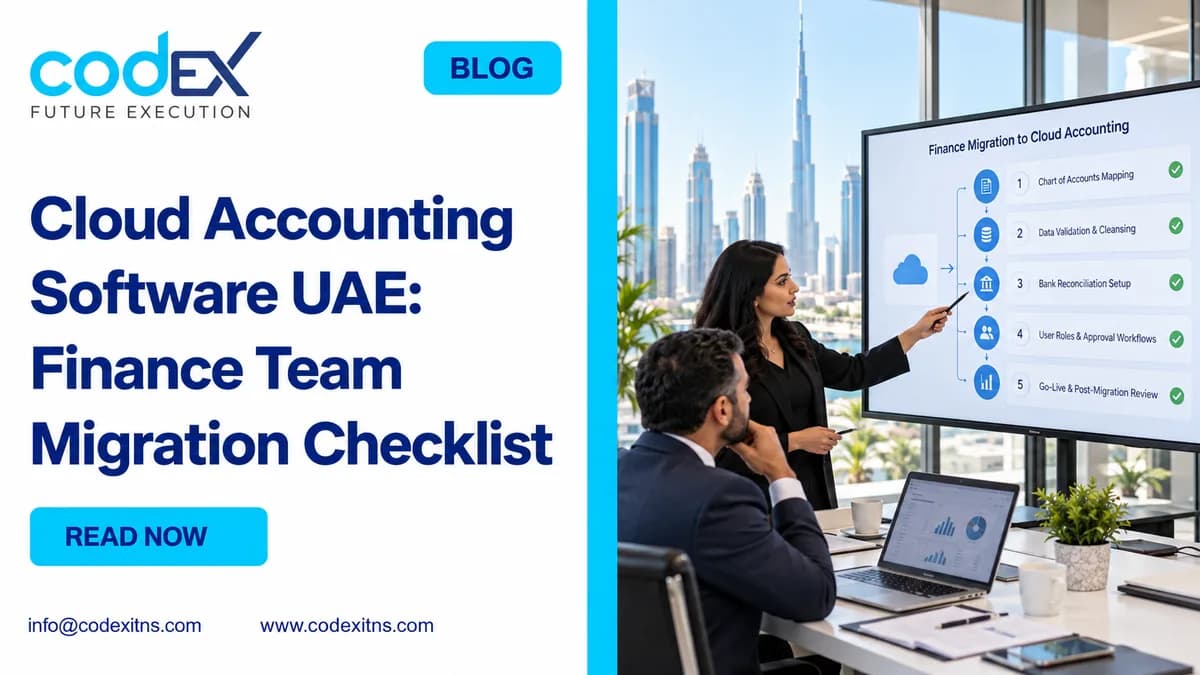
| Phase | Main finance decision | Typical output |
|---|---|---|
| 1. Discover | Scope, entities, posting sources, reporting needs | Approved migration scope and ownership list |
| 2. Design | Chart, dimensions, taxes, approvals, bank setup | Target finance blueprint |
| 3. Prepare data | Masters, balances, open items, mapping rules | Validated import files and mapping sheets |
| 4. Test | Posting, reconciliation, approvals, reports, integrations | Signed UAT scenarios and issue log |
| 5. Cut over | Final balances, freeze point, user access | Go-live checklist and cutover sign-off |
If you need implementation support around this structure, our team provides Odoo implementation services for businesses that want accounting aligned with procurement, inventory, HR, project, or service workflows from the start.
Data migration checklist: what to clean, what to move, and what to leave behind
Data migration should be handled as a finance control exercise, not an IT upload task. Question: what data should be cleaned and validated before migration? Answer: all records that affect opening balances, outstanding items, tax treatment, bank reconciliation, customer and supplier settlements, and management reporting. Historical noise that users never reference does not always belong in the first go-live scope.
Migration checklist for finance teams
- Freeze the source-system extraction date and define who can still post after that point.
- Clean customer, supplier, item, employee-expense, and bank master duplicates.
- Validate inactive accounts and decide whether they will be merged, mapped, or retired.
- Map old GL codes to the new chart and test one-to-many or many-to-one mappings carefully.
- Prepare opening trial balance by entity, and reconcile it to the last approved close.
- Load open receivables and payables at invoice level if collection and payment follow-up will continue in the new system.
- Decide treatment of unpresented cheques, post-dated instruments, advances, deposits, accruals, and prepayments.
- Confirm inventory valuation source if stock accounting is in scope; finance and operations must sign off the same value.
- Prepare fixed asset registers with acquisition value, accumulated depreciation, and useful-life logic if asset accounting is moving.
- Reconcile bank balances to statements and unresolved reconciling items before final cutover.
Do not migrate historical transactions “just in case” without a retrieval requirement. Finance should classify history into three buckets: must transact in new system, must be searchable in new system, and can remain in archived source records. That decision keeps the project proportionate and reduces test volume.
This is also where this article differs from our VAT and month-end content. There, the focus is close-cycle operation after go-live. Here, the finance question is whether migrated balances, open items, tax mappings, and report comparatives are accurate enough to start operating without creating avoidable cleanup work in the first closing period.
Controls, banking, reporting, and integrations to configure early
Many migration delays happen after data loads, when teams realize the system can post transactions but not govern them. Configure controls early: bank journals, payment methods, approval matrices, posting rights, edit restrictions on closed periods, supplier bill workflows, and credit control rules. Those decisions affect testing scripts as much as they affect governance.
Question: what integrations should UAE businesses review before implementation? Start with any process that creates accounting entries or changes customer balances, stock value, payroll cost, or collections. In practice this usually means payroll, POS, ecommerce, inventory, purchasing, CRM-to-invoice handoff, expense tools, and bank-related import or payment files. If any one of these stays manual, finance needs a clear fallback process and responsibility matrix.
Reporting should also be defined before go-live. Finance managers should specify trial balance, P&L, balance sheet, cash position, receivables aging, payables aging, cost center reports, branch comparisons, project profitability, and exception reports for unreconciled entries. When we set up accounting-led Odoo projects, we ask finance to rank reports as day-one mandatory, first-month required, or later enhancement; that prevents dashboards from consuming time that should go into transaction control.
If your migration will sit inside a broader connected platform, review our guidance on accounting software for UAE finance teams and implementation planning with structured Odoo deployment services. For multi-system environments, the handoff rules matter as much as the accounting configuration itself.
Testing, cutover, user adoption, and when to bring in expert help
User acceptance testing should follow end-to-end finance scenarios, not isolated button clicks. Test supplier invoice to payment, sales invoice to receipt, expense approval to posting, stock movement to valuation entry, payroll journal import, bank statement reconciliation, and period lock controls. Each test should confirm both accounting output and user responsibility: who creates, who approves, who posts, and who reviews exceptions.
Cutover planning needs a short written runbook. It should state the freeze date, final extraction time, last postings in the old system, import sequence, validation reports, user-creation steps, and go-live sign-off owners. For UAE SMEs, migration timing often depends less on company size than on entity count, transaction complexity, reporting expectations, and whether inventory or payroll integrations are included.
When should you get expert help? Bring in an implementation partner if you have multi-company reporting, stock-linked accounting, project costing, service contracts, custom approval chains, or several source systems feeding finance. These are not reasons to avoid migration; they are reasons to manage design and testing with more discipline. Our role at CodeEX is to help companies convert those real operating workflows into a structured Odoo accounting rollout rather than a basic software swap.
If you are planning a controlled migration, speak with CodeEX about scoping your finance structure, migration files, approval model, and integration sequence before configuration begins. A short discovery workshop can often surface the decisions that determine whether go-live is orderly or disruptive.
Related Articles
- Best Practices For Error Free Data Migration With Odoo Implementation Services
- Payroll Wps Software Uae
Cloud Accounting Software UAE Migration Checklist
Practical cloud accounting software UAE migration checklist for finance teams covering data, controls, integrations, reporting and go-live readiness.
Frequently Asked Questions
How do finance teams prepare for moving to cloud accounting software in the UAE?

What data should be cleaned and validated before migrating to a new accounting system?
How should opening balances and chart of accounts be handled during migration?
What integrations should UAE businesses review before implementing cloud accounting software?
How long does a cloud accounting software migration typically take for an SME in the UAE?
Should we migrate full transaction history or only opening balances?