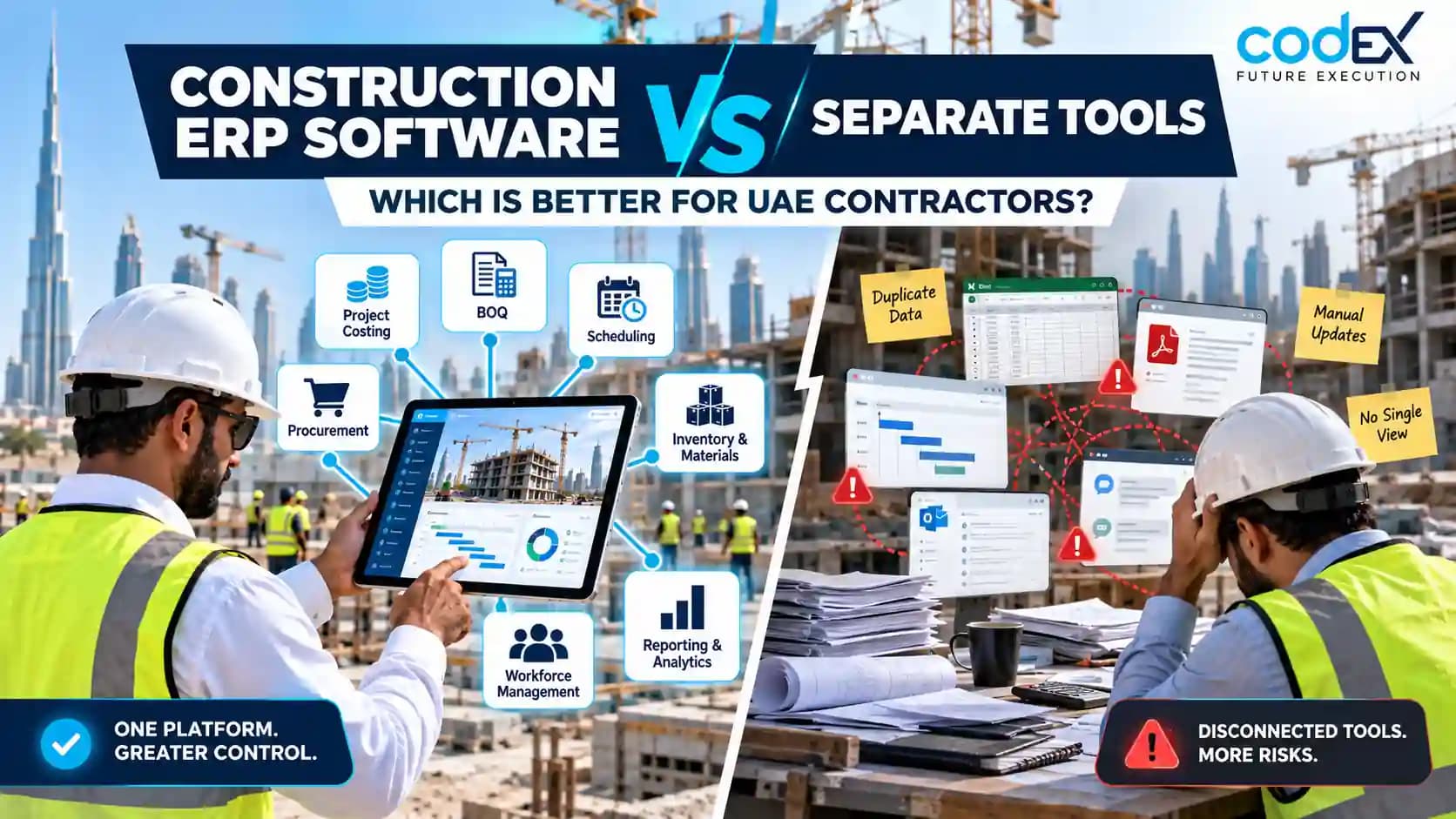
For most growing contractors, construction ERP software is the better long-term choice because it connects estimating, procurement, site operations, subcontractors, payroll, and finance in one system. Separate tools can still work for very small firms or short project cycles, but once a business is managing multiple sites, retention, variation orders, and UAE VAT requirements, fragmented software usually creates more control problems than it solves.
In practical terms, construction ERP software is a centralized platform built around real project workflows: BOQ-driven purchasing, subcontractor progress claims, material issues to site, plant allocation, labor costing, document control, and project-wise profitability. That matters in the UAE, where payment delays, compliance documentation, and contract administration directly affect margin and cash flow.
What the two approaches look like in practice
Many UAE contractors are not choosing between “manual” and “digital.” They are choosing between two digital operating models. The first is a stack of separate tools: spreadsheets for BOQs and cost tracking, WhatsApp or email for approvals, a project app for site updates, and accounting software for invoices and ledgers. The second is an integrated environment where these activities share one database.
The difference is not cosmetic. It changes how quickly a variation reaches commercial review, whether a material request becomes a controlled purchase order, and whether head office sees committed cost before the supplier invoice arrives. That is why this decision affects both execution and margin protection.
| Criteria | Construction ERP software | Separate tools |
|---|---|---|
| Data model | Single source of truth across projects, procurement, HR, and finance | Data copied between spreadsheets, apps, and accounting systems |
| Project costing | Live actuals, commitments, and budget comparisons by job and cost code | Often delayed until invoices are posted or spreadsheets are updated |
| Variation control | Structured approvals, commercial visibility, audit trail | Commonly tracked in email chains and ad hoc files |
| Subcontractor management | Claims, retention, certifications, and payment status in one workflow | Handled across procurement, accounts, and site teams separately |
| UAE VAT and finance | Integrated invoicing, advances, retention handling, and reporting | Higher risk of timing errors and duplicate entry |
| Document control | Linked RFIs, submittals, drawings, and approvals to projects | Documents stored in folders without transaction linkage |
| Implementation effort | Higher upfront process design and configuration effort | Lower immediate disruption, but growing maintenance complexity |
| Best fit | SMEs and mid-sized contractors scaling across sites or entities | Very small firms with simple jobs and low transaction volume |
Contractors assessing a unified model should look at a purpose-built Construction Contracting Industry Solution rather than a generic office system. The relevant question is not whether software has “projects,” but whether it can control site, commercial, and finance workflows together.
Why many UAE contractors still use separate tools
Separate tools survive for understandable reasons. Teams can adopt them quickly, specialist departments keep familiar software, and there is less immediate pressure to redesign processes. A quantity surveyor may prefer Excel for interim valuations, a site engineer may use a simple app for daily reports, and finance may stay on legacy accounting software because statutory reporting already works.
For a small contractor running a limited number of straightforward jobs, this setup can be enough. If purchasing is centralized, subcontractor complexity is low, and the owner still personally checks most commercial decisions, the hidden cost of fragmentation may not yet justify a full platform change. In that narrow context, separate tools offer flexibility with minimal upfront investment.
Where separate tools usually perform well
- Short-duration projects with modest procurement volume
- Single-entity businesses with one office and limited branch activity
- Low customization needs and basic accounting requirements
- Teams that do not yet need formal approval workflows or cost codes
The limitations appear when the business grows faster than its controls. Different versions of the same budget circulate, site teams raise urgent material requests outside procurement, and committed cost is invisible until invoices are entered. That is the classic “app fatigue” problem: each department has a tool, but management has no dependable operational truth.
Building integrations between those tools can help, but it rarely solves process inconsistency. If one system treats a subcontract variation as a note, another as a purchase change, and finance recognizes it only at invoice stage, an API connection does not create governance. It only moves inconsistent data faster.
Where construction ERP software is stronger for UAE contractors
The core strength of construction ERP software is transaction continuity. A BOQ item can flow into a budget, a material request into a purchase order, a GRN into inventory or direct project consumption, and then into supplier liability and job costing without rekeying. For UAE contractors handling multiple active sites, this is often the point where finance and operations finally reconcile in real time rather than at month-end.
This is especially valuable in workflows that commonly leak margin. Variation orders, provisional sums, plant allocation, labor timesheets, and subcontract claims all affect project profitability before they appear in the final accounts. A connected system surfaces those movements early enough to act on them.
Can site reports and material requisitions reach procurement and accounts in real time?
Yes, if the platform is configured around field-to-back-office workflows. A contractor using Odoo Construction Project Management Software can route site requests, progress updates, and approvals into central purchasing and project cost tracking instead of leaving them in messaging threads. The value is less about speed alone and more about controlled traceability.
How does Odoo manage labor costing and equipment allocation across sites?
It can assign employees, subcontract crews, and plant to projects, activities, or cost centers, then push those costs into job-level reporting. When configured properly, the result is visibility by project, package, and period: planned versus actual labor, idle equipment risk, and the cost impact of redeployment between Dubai and Abu Dhabi sites. That is one reason many firms evaluating Codexitns for construction ERP in UAE are really trying to fix commercial control, not just software sprawl.
ERP is not without trade-offs. It requires process mapping, role definitions, master-data discipline, and often some level of industry-specific configuration. But those demands are also what make the system reliable once project volume increases.
How separate systems create risk in costing, compliance, and margin
UAE contractors operate in a demanding environment: owner payment delays, strict approval chains, and extensive documentation obligations tied to drawings, submittals, RFIs, HSE records, and municipal compliance. If document control sits in one repository, purchasing in another, and accounts in a third, teams spend too much time proving what was approved, delivered, billed, or withheld. According to Arcadis Global Construction Disputes Report, the average dispute value in the Middle East reached $86 million, underscoring the cost of weak contract administration and poor payment governance.
The commercial risk shows up first in variation handling. A site instruction may be executed before the corresponding commercial approval is logged. If that variation is not tied to revised budget, subcontract impact, material demand, and client billing, profit leakage becomes almost inevitable. This is the margin protection issue many contractors only quantify after a job starts drifting.
How does ERP handle retention and progress billing under UAE VAT guidelines?
It can structure interim applications, certified amounts, retention deductions, advances, and tax invoices inside the same accounting flow. That is far safer than using separate spreadsheets and finance tools when dealing with common retention terms that may hold back around 10% until contractual milestones are achieved. It also helps finance align invoicing and reporting with Federal Tax Authority requirements for tax points, advances, and credit adjustments.
Procurement is the second pressure point. When daily material consumption, stock transfers, and supplier commitments are not linked to project budgets, buying teams cannot distinguish urgent operational demand from avoidable over-ordering. The result is excess stock on one site, shortages on another, and distorted project margins because committed cost is recognized too late.
Document-heavy contractors should also consider purpose-built controls such as Odoo Construction Document Control Software and Odoo Construction Subcontractor Management Software. Those workflows matter more than generic task management because UAE disputes often turn on certification status, approved quantities, drawing revisions, and subcontract evidence.
Which should you choose? Decision criteria for UAE contractors
If your company still runs on a handful of low-volume projects, limited subcontracting, and owner-led approvals, separate tools may remain acceptable for now. The key is honesty about scale. Once you need project-wise profitability before month-end, cross-site stock visibility, formal variation governance, or multi-company consolidation, the administrative cost of fragmentation usually exceeds the cost of a proper implementation.
A practical decision framework is to assess five areas: transaction volume, project complexity, compliance pressure, branch/site count, and reporting latency. If any of these are rising sharply, the software decision is no longer an IT preference; it becomes an operating model decision.
Choose construction ERP software if you need:
- Live visibility of budget, actual cost, and committed cost by project
- Integrated procurement from requisition through supplier billing
- Retention, subcontract claims, and progress billing controls
- Documented approval trails for RFIs, submittals, and variations
- Unified HR, payroll, plant, and finance across multiple sites or entities
Keep separate tools a bit longer if you have:
- Very small teams and low monthly transaction volumes
- Simple project structures with limited subcontract packages
- No immediate need for multi-site or multi-branch coordination
- A near-term plan, budget, and governance model for future migration
For many UAE firms, the strongest middle path is not “ERP versus no ERP,” but an industry-configured Odoo rollout with targeted customization, staged migration, and local support. That is where implementation planning, Odoo customization and development services, and ongoing support become decisive. The right system should fit your commercial and site workflows, not force contractors into generic templates.
Related Articles
- Construction Erp Uae Top Challenges And How Erp Solves Them
- Construction Erp Uae Driving Project Management Efficiency In Construction Firms
- Erp Software Solutions Uae Tackling Key Challenges For Successful Erp Implementation
- Odoo Construction Subcontractor Management Software
- Amc Management Software Uae Odoo Guide
- Fmcg Distribution Software Uae Batch Expiry Promotion Management
Construction ERP Software vs Separate Tools UAE
Compare construction ERP software vs separate tools for UAE contractors. See which setup improves costing, procurement, VAT control and visibility.
Related solution: Field Service and AMC Management Software explains how Codex handles this workflow for UAE businesses.
Planning AMC or field service operations? See how Codex connects service contracts, technician visits, renewals, spare parts, and invoicing in one Odoo workflow. Explore Field Service and AMC Management Software or talk to Codex for a guided consultation.
