Odoo Fit-Gap Analysis in Dubai: How to Scope ERP Requirements Before Implementation
 General
Odoo Fit-Gap Analysis in Dubai: How to Scope ERP Requirements Before Implementation
If you are planning an odoo implementation dubai project, the most important step is not configuration, training, or data import. It is fit-gap analysis: the structured process of comparing your real workflows against standard Odoo capabilities before scope, budget, and timelines are approved. Done properly, it helps UAE companies avoid vague requirements, unnecessary custom development, and late surprises around VAT, payroll, inventory, and multi-branch operations.
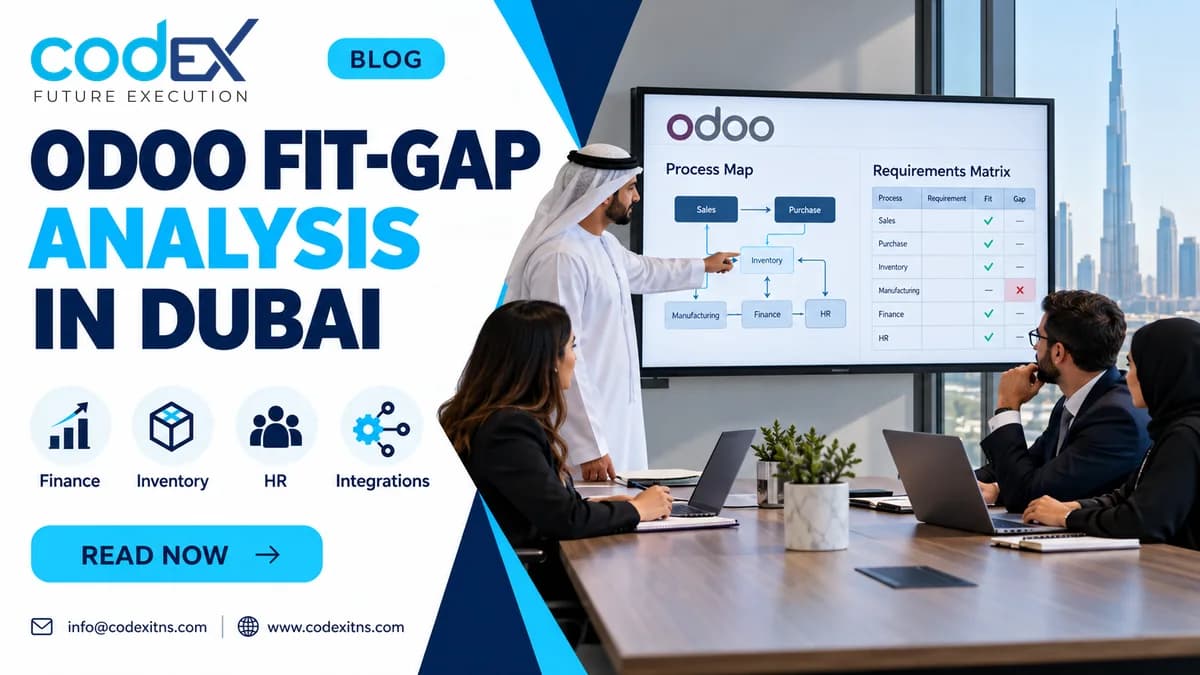
What is Odoo fit-gap analysis? In simple terms, a fit is a process Odoo can handle through standard configuration, while a gap is a requirement that needs workflow change, customization, integration, or a phased workaround. For Dubai SMEs moving from Excel, Tally, or disconnected systems, fit-gap analysis becomes the blueprint that decides what gets implemented in phase one and what should wait.
Step 1: Define what fit-gap analysis must produce before implementation starts
Many UAE businesses think scoping means collecting module names such as accounting, inventory, HR, and CRM. That is not enough. A professional fit-gap exercise should produce a requirement register, current-state process maps, future-state process decisions, fit-gap classification, integration notes, data migration scope, report list, and measurable acceptance criteria.
This is why a standard demo is not a scoping method. A demo shows generic product capability; fit-gap analysis tests whether your exact approval chains, branch controls, job costing rules, procurement tolerances, or payroll inputs can be handled without rework. For companies comparing vendors, that distinction matters more than polished presentations.
For UAE projects, the scoping output should also identify local dependencies early. Examples include FTA VAT treatment, branch-level stock visibility, Arabic or bilingual document needs where relevant, WPS payroll handling, and any external systems that cannot be retired on day one. This is where a structured Odoo consultation and process analysis service is more useful than a feature checklist.
Practical tip: Do not approve a proposal that lists only modules and user counts. Ask for requirement-level scope, fit-gap classification, assumptions, exclusions, and phase boundaries.
What deliverables should you expect?
- Requirement matrix: each requirement mapped to fit, gap, workaround, or future phase
- Solution notes: standard configuration, custom logic, or integration path
- Risk log: data quality, process ownership, timeline constraints, and external dependencies
- Scope sign-off pack: what is included, excluded, deferred, and how acceptance will be tested
Step 2: Map current workflows across finance, sales, inventory, HR, and operations
The next step is to document how work actually moves today, not how management assumes it moves. In Dubai trading, construction, service, and retail companies, the real process often sits across WhatsApp approvals, Excel trackers, Tally exports, manual stock adjustments, and branch-specific workarounds. If those exceptions are ignored, the implementation team will discover them only after configuration has started.
Start by mapping each major flow end to end. Finance should cover quotation to invoice, payment allocation, expense approval, tax posting, and management reporting. Inventory should cover item creation, purchasing, receipts, putaway, transfers, reservations, delivery, returns, adjustments, and branch replenishment. HR should cover employee master data, attendance inputs, leave, payroll variables, and handoff to accounting.
Ask direct questions during workshops. Where does data get re-entered? Which approvals are mandatory and which are habit? What reports are manually rebuilt every month? Which process breaks when one key employee is absent? Those answers reveal hidden gaps faster than screenshots do.
For industry-specific rollouts, process mapping should reflect operational reality. A contractor may need job cost coding and subcontractor-linked purchasing, while a retailer may need branch transfer controls and real-time stock reservations. If your business has a specialized workflow, such as optical retail, reviewing examples from Odoo ERP for optical stores and chains can help stakeholders describe requirements in operational terms rather than software jargon.
Common mistake to avoid: documenting only the “happy path.” Exception handling, returns, partial deliveries, credit notes, negative stock controls, and off-cycle payroll events usually create the biggest scope changes later.
Step 3: Rank requirements by business criticality, not by who speaks loudest
Once processes are mapped, convert them into requirement statements that can be tested. Good requirements are specific and observable: “system must block delivery when reserved stock is insufficient,” “project purchase orders must carry job cost code,” or “payroll journals must post by cost center.” Weak requirements such as “better inventory control” create scope disputes because nobody can verify them.
The most useful prioritization model for UAE SMEs is simple: must-have, should-have, could-have, and defer. Must-haves are the requirements without which go-live fails operationally or financially. Should-haves improve control but can wait for phase two. Deferred items are legitimate ideas that should not consume phase-one budget.
This step is where many businesses either avoid or trigger the customization trap. If every current habit becomes a must-have, the project turns into bespoke software wrapped inside Odoo. A stronger approach is to separate true business constraints from inherited habits. Sometimes changing a weak manual process is cheaper and safer than coding it.
| Requirement type | Example in UAE operations | Recommended treatment |
|---|---|---|
| Must-have | VAT-ready invoice flow, branch stock visibility, payroll posting rules | Deliver in phase one with defined test cases |
| Should-have | Advanced dashboards, secondary approval reminders, optional alerts | Include if timeline allows and dependency is clear |
| Could-have | Nice UI changes, extra print layouts, noncritical automations | Estimate separately and review after core go-live |
| Defer | Low-volume edge cases or experimental process changes | Move to later phase with business owner approval |
If your team is comparing local partners, this prioritization discipline is often more valuable than sales claims. A knowledgeable Odoo partner in Dubai should be able to challenge requirements constructively, explain trade-offs, and document why something belongs in phase one, later, or not at all.
Practical tip: Assign one business owner per process area. If three departments “own” the same requirement, sign-off becomes slow and accountability disappears.
Step 4: Check standard Odoo capability before requesting customization
After prioritization, each requirement should be tested against standard Odoo behavior. This means reviewing native models, user roles, workflows, approval logic, reporting options, and configuration settings before writing custom specifications. Too many Dubai projects jump directly to development because teams assume their process is unique when Odoo can already handle most of it through setup.
When should you customize instead of configure? Customize only when the requirement creates material business value, cannot be solved by standard configuration, and will remain stable enough to justify future maintenance. Typical examples include highly specific approval rules, third-party API exchanges, industry-specific calculations, or branch policies that Odoo cannot represent cleanly out of the box.
Should your business change to fit Odoo? Usually, yes for low-value habits and redundant manual controls; no for critical financial controls, industry-specific operational logic, or local obligations that must be preserved. The goal is not to force your team into generic software behavior. The goal is to decide where standardization is healthy and where customization is justified.
This evaluation is especially important for companies planning phased rollout. A phased approach often delivers faster ROI because accounting, purchasing, inventory, and sales can go live before advanced automation, niche reports, or noncore integrations. That reduces the risk of paying twice: once for rushed custom code and again for rework when requirements become clearer. Businesses evaluating implementation models can also review full-cycle Odoo implementation expectations before approving scope.
Common mistake to avoid: approving custom development from workshop notes alone. Ask for a clear functional design, impacted modules, upgrade implications, and acceptance criteria first.
Questions to ask before approving a customization
- Can standard Odoo configuration solve 80 to 90 percent of the need?
- Will the custom logic affect upgrades, performance, or reporting?
- Is the requirement legally, operationally, or commercially critical?
- Can the need wait until after core go-live and user adoption?
Step 5: Lock integrations, migration, compliance dependencies, and acceptance criteria before sign-off
The final scoping step is where many ERP projects either become controlled or drift into endless change requests. Before sign-off, document every system that must exchange data with Odoo: eCommerce, bank files, biometric attendance, legacy payroll, POS, third-party logistics, customer portals, or industry systems. Each integration needs direction, trigger, data fields, ownership, error handling, and testing responsibility.
Data migration needs the same discipline. Define what will move, from where, in what format, and at what level of history. Master data usually includes customers, suppliers, items, chart of accounts, employees, and opening balances. Transactional history is more expensive and should be justified carefully; many businesses only need opening balances, open invoices, open orders, inventory on hand, and active employee records.
UAE-specific dependencies should also be explicit during fit-gap analysis. For finance teams, that may include VAT configuration and reporting logic aligned with Federal Tax Authority expectations. For HR, it may include payroll structures, leave policies, gratuity assumptions, and WPS-related file generation where applicable. For operations, it may include branch structure, warehouse design, or project cost coding. These topics should be reviewed functionally first, then configured and tested against the agreed requirement set.
Finally, write acceptance criteria for every critical requirement. Instead of saying “inventory should work,” define the exact test: create purchase order, receive partial quantity, reserve stock for sales order, deliver balance from branch warehouse, process return, and validate accounting impact. That is the real protection against scope arguments. For buyers comparing providers, articles such as how to choose the right Odoo implementation partner in Dubai and industry-specific examples like Odoo implementation in Dubai for construction costing can help frame the right sign-off questions.
Practical tip: Do not sign off scope until each critical process has an owner, a test scenario, and a clear statement of what is excluded from phase one.
If you are preparing for an implementation and want a requirement-led approach instead of a generic demo, CodeEX can run a structured discovery workshop, map your workflows, classify fits and gaps, and define a realistic rollout path for your UAE operations. Start with a scoped review through process analysis and consultation, then move into implementation only after the business, technical, and reporting requirements are signed off.
Related Articles
- Odoo Erp Implementation Services What Optical Businesses Must Ask Before Choosing An Erp
- Odoo Consultation Process Analysis
- Audit Management Software Requirements Uae Firms
- Odoo Implementation Dubai Construction Costing
- How To Choose The Right Odoo Implementation Partner In Dubai
- Odoo Erp Cost In Uae Pricing Implementation Hidden Expenses Explained
Odoo Implementation Dubai: Fit-Gap Analysis Guide
Learn how to scope Odoo implementation Dubai projects with fit-gap analysis to reduce rework, customization risk, and rollout delays.
Running an optical store or chain? Explore the Codex optical ERP solution for prescription records, POS, inventory, branch controls, customer history, and reporting. Explore Odoo ERP for Optical Stores and Chains or talk to Codex for a guided consultation.
Frequently Asked Questions
What is fit-gap analysis in an Odoo implementation?

Why should UAE companies complete fit-gap analysis before configuring Odoo?
How do you separate must-have ERP requirements from nice-to-have requests?
When does a business process need Odoo customization instead of standard configuration?
What should be approved before signing off the Odoo implementation scope?
How long does a professional Odoo fit-gap analysis take for a mid-sized UAE company?