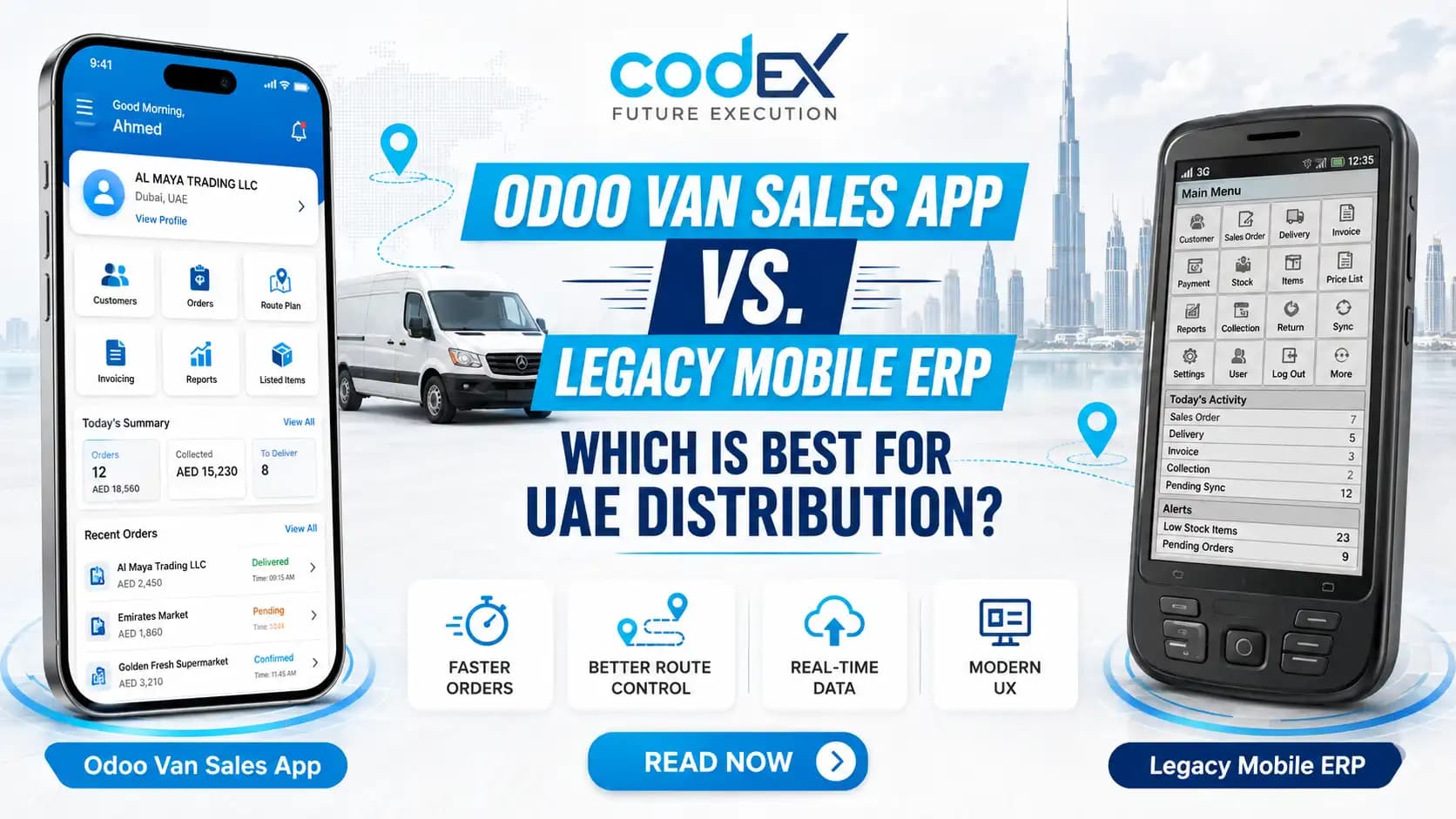
Odoo Van Sales App vs. Legacy Mobile ERP: Which Is Best for UAE Distribution?
 General
Odoo Van Sales App vs. Legacy Mobile ERP: Complete Guide to Van Sales and Route Distribution with Odoo
For UAE distributors, the better option is usually the platform that keeps van stock, route sales, invoicing, collections, and accounting in one live system rather than pushing data back to head office at the end of the day. This Complete Guide to Van Sales and Route Distribution with Odoo compares that integrated model with older mobile ERP setups that still depend on handheld devices, batch synchronization, and siloed databases.
This comparison matters because route-based trading businesses in Dubai, Abu Dhabi, Sharjah, and the wider UAE are under pressure to invoice on the spot, reconcile stock accurately, and keep branch, warehouse, and finance teams aligned. In that environment, the question is not simply which mobile app looks modern; it is which architecture fits real field operations.
Why UAE distributors are re-evaluating legacy van sales systems
In a typical legacy environment, the van driver starts the day with a preloaded inventory file, customer balances copied from a back-office system, and pricing pushed to a handheld terminal. Transactions are captured in the field, but the central ERP often does not see those updates until the device is docked or synchronized later. That design was workable when route operations were smaller and product ranges were simpler, but it becomes risky once a business is managing multiple vehicles, depots, credit customers, returns, and mixed payment methods across the UAE.
The operational pain points are predictable. Sales teams may quote stock that has already been consumed by another route. Finance receives cash, card, and credit activity late. Warehouse planners cannot reliably allocate tomorrow's load because today's van movement is still sitting on a device. These gaps are especially costly in FMCG, beverage, food distribution, and temperature-sensitive trade where rapid replenishment decisions matter.
There is also a compliance angle. UAE invoicing requirements have become more structured, and distributors increasingly want simplified tax invoices generated immediately in the field, with Arabic and English formatting where required. The UAE Federal Tax Authority provides the governing guidance, and many businesses no longer want compliance to depend on manual re-entry after route completion.
That is why many companies now compare traditional tools with an integrated option such as Odoo Van Sales ERP. The conversation has shifted from basic mobility to real-time operational control.
Feature-by-feature comparison: Odoo van sales app vs. legacy mobile ERP
A van sales platform for UAE distribution should be judged on workflow depth, not marketing labels. Buyers need to examine how the system handles route loading, live stock deduction, returns, collections, central accounting, VAT-compliant invoicing, and offline use when drivers move through weak-connectivity areas.
| Criteria | Odoo Van Sales App | Legacy Mobile ERP |
|---|---|---|
| System architecture | Connected to the central Odoo database with shared inventory, sales, accounting, and customer data | Often uses a separate mobile database that syncs later |
| Inventory visibility | Van stock, warehouse stock, and route movements can be viewed in the same environment | Commonly limited to last synced quantities on the device |
| Offline operation | Can continue field transactions offline and sync once connectivity returns, subject to app design and implementation | Usually supports offline capture, but often with heavier end-of-day batch reconciliation |
| Invoicing | Immediate sales invoice generation with direct accounting impact and printer integration options | Receipt first, accounting update later in many deployments |
| Collections | Cash, card, and credit activity can flow into central accounting workflows | Reconciliation is frequently manual or delayed |
| Hardware model | Device-agnostic Android or iOS mobility options depending on solution design | Often tied to proprietary handheld terminals |
| Customization | Can adapt to route, trade terms, schemes, approvals, and industry workflows | Changes may require vendor-specific development on aging platforms |
| Integration | Native connection with Odoo inventory, accounting, CRM, fleet, and warehouse processes | Middleware or custom connectors are often needed |
The biggest practical difference is timing. In Odoo, a field transaction can become a stock move, customer invoice, payment record, and route activity inside one operational system. In legacy tools, those events are frequently split across devices and later reconciliation cycles.
For a broader operational picture, CodeEX's trading, manufacturing, and van sales solution and its article on van sales and route distribution with Odoo provide complementary detail beyond the comparison in this piece.
Where Odoo is stronger, and where it still needs implementation discipline
Odoo's main strength is not that it is a mobile app; it is that the mobile workflow can sit inside the same business platform used by sales administration, purchasing, warehousing, receivables, and management reporting. A route sale can update customer exposure, trigger accounting entries, and affect replenishment decisions without waiting for a batch cycle. For businesses with multiple depots or branch operations, that shared data model is a significant advantage.
Another important strength is lower architectural friction. Instead of maintaining a stand-alone van sales application plus connectors into finance and inventory, the business can keep those functions closer together. That often reduces duplicate master data problems such as customer pricing mismatches, route-specific item lists, and outdated receivable balances shown to the driver.
What Odoo is best suited for
It is particularly well suited to UAE trading and FMCG distributors that need route accounting, branch visibility, returns handling, and central stock control. It also fits companies that want to extend the solution later into purchasing, warehouse management, or broader ERP processes through Odoo ERP implementation in the UAE rather than keeping van operations isolated forever.
That said, Odoo is not a shortcut. Results depend on process design, mobile UX choices, tax invoice formatting, route logic, and how van loading and unloading are modeled. If the implementation team does not understand route distribution, an integrated platform can still be configured poorly. Buyers should assume some migration planning, data cleanup, and workflow redesign will be necessary.
Where legacy mobile ERP still fits, and its trade-offs
Legacy mobile ERP systems are not automatically wrong. Some distributors keep them because drivers know the screens well, the hardware is rugged, and the process is stable for a narrow route-selling model with limited SKUs and simple pricing. If the business only needs order capture and end-of-day upload, an older platform may continue to function acceptably for a time.
Those systems can also suit operations that are heavily standardized around a particular device fleet or have not yet committed to wider ERP consolidation. In some GCC deployments, the van application was designed years ago around one task only: sell, print, and synchronize later. When the surrounding business is also fragmented, replacing that component may not be the first priority.
The limitations buyers should weigh carefully
The weaknesses become clear once the business wants more than basic field capture. Proprietary hardware can raise total cost of ownership through device replacement, support contracts, and dependency on specialist vendors. Integration into finance, inventory, and reporting frequently requires custom connectors, which makes change slower and troubleshooting harder.
There is also a structural data issue. Batch-based synchronization means planners and finance teams work with stale information during the day. If a route runs short of fast-moving stock, if a customer disputes credit exposure, or if management wants live route performance, the system may simply not be designed to answer those questions well. For growth-oriented distributors, that limitation usually matters more than familiarity.
Which should you choose? Decision criteria for UAE route distribution
If your company operates across Dubai and other emirates with multiple routes, fast-moving inventory, daily collections, and pressure for immediate invoicing, Odoo is usually the stronger long-term choice. It is especially compelling when you want one environment for van stock, warehouse inventory, receivables, route sales, and management reporting. Businesses evaluating Codex typically reach this stage when spreadsheets and disconnected tools can no longer support route complexity.
Choose a legacy system only if your operation is narrow, stable, and unlikely to require real-time visibility or broader ERP integration. That can still be rational for a small fleet with limited product variation, minimal reporting needs, and an existing device estate that is already paid for. Even then, buyers should compare the cost of staying put against the hidden cost of delayed data and manual reconciliation.
Questions to ask before deciding
- Do you need live van inventory and central warehouse visibility during the day? If yes, the integrated Odoo model is better aligned.
- Will drivers invoice and collect payments on the spot? If yes, ensure the solution supports printer integration and compliant tax invoice layouts.
- Do you operate offline in remote zones? Confirm the app's offline-first behavior, conflict handling, and sync rules in detail.
- Are branch, warehouse, and finance teams reconciling manually today? That is often the clearest sign that a batch-based tool has reached its limit.
- Will you expand beyond van sales? If the answer includes purchasing, warehousing, CRM, or accounting consolidation, choose the platform with a broader ERP path.
Implementation capability matters as much as product choice. A suitable partner should understand route loading, returns, customer credit rules, pricing structures, fleet realities, and support obligations after go-live. That is where the value of an Odoo partner becomes practical rather than theoretical.
Operational issues to plan for during replacement
Most migration problems are not caused by the mobile app itself. They come from master data inconsistency: duplicate customer records, weak product units-of-measure, informal route ownership, and unclear rules for damaged stock, returns, promotions, and credit blocking. Before replacing a legacy platform, businesses should map the exact route workflow from vehicle loading to cash handover and end-of-day reconciliation.
A second planning area is infrastructure and field equipment. Buyers should test Bluetooth thermal printer compatibility, receipt format requirements, and offline behavior under weak connectivity conditions rather than relying on vendor assumptions. The relevant Odoo ecosystem options can be reviewed through the Odoo App Store, but the live implementation still needs scenario-based testing with your own route process.
Multi-warehouse and multi-branch design is equally important in the UAE. A distributor may load vans from one depot, replenish from another, and report sales centrally. Those movements must be modeled correctly inside inventory and accounting so route profit, stock aging, and customer balances remain trustworthy. For that reason, van sales should not be treated as an isolated app project; it should be aligned with broader distribution workflows and ongoing support and maintenance.
Businesses that prepare these foundations usually find the switch manageable. Businesses that skip them often blame the software for issues that actually come from undefined process rules.
Related Articles
- Complete Guide To Van Sales And Route Distribution With Odoo
- Odoo Van Sales Erp
- Trading Manufacturing Van Sales Solution
- Complete Guide To Odoo For Optical Stores
- The Complete Guide To Odoo Erp Implementation In The Uae 2026 Edition
- A Step By Step Guide To Migrating To Odoo Erp Without Business Disruption
Complete Guide to Van Sales and Route Distribution with Odoo
Complete Guide to Van Sales and Route Distribution with Odoo: compare Odoo van sales app vs legacy mobile ERP for UAE distributors.
Need a van sales rollout for your field team? Review the Codex van sales solution for route planning, mobile ordering, stock control, invoicing, payments, and daily reporting. Explore Odoo Van Sales Solution or talk to Codex for a guided consultation.
Frequently Asked Questions
What is the difference between Odoo Van Sales App and a legacy mobile ERP system?

Is Odoo suitable for FMCG, trading, and route distribution businesses in the UAE?
Can Odoo manage van inventory, invoicing, collections, and route sales in real time?
How does Odoo handle offline transactions in remote UAE regions?
Can Odoo print FTA-compliant invoices from the van using Bluetooth printers?
Does Odoo support multi-branch distribution operations across Dubai and the UAE?