Inventory vs Warehouse Management Software: Differences, Benefits and How Odoo Connects Both
 General
Inventory vs Warehouse Management Software: Differences, Benefits and How Odoo Connects Both
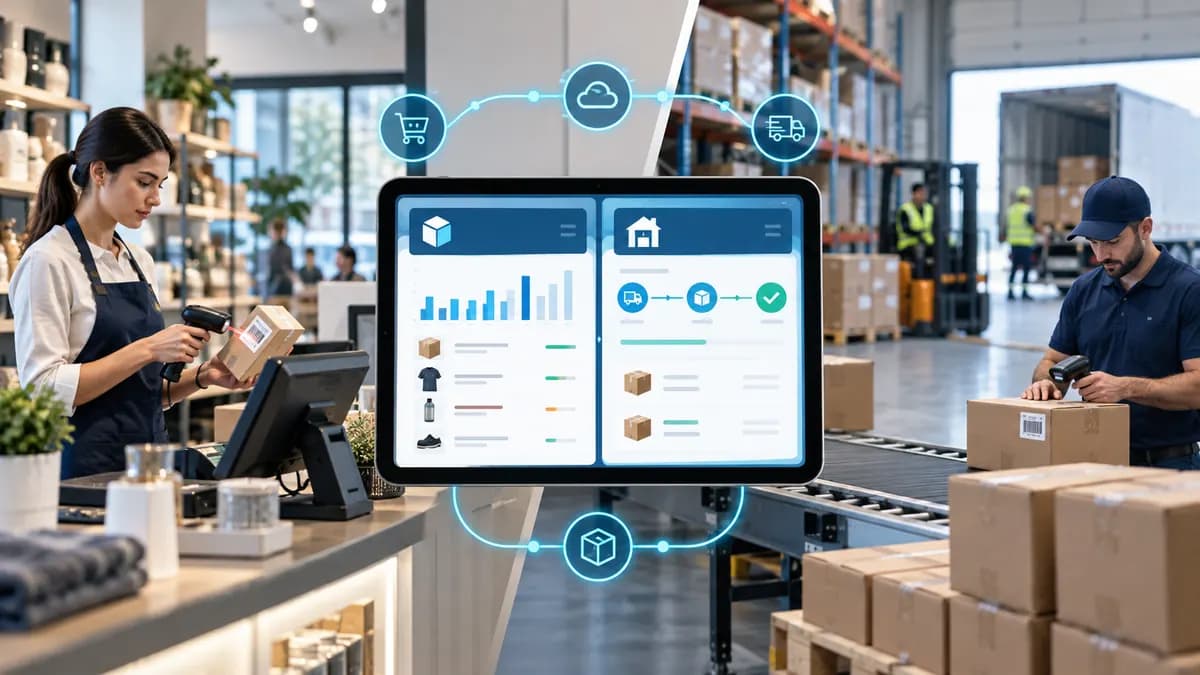
Inventory and warehouse management software solve related but different problems. Inventory management controls what stock you have, where it is at a business level, what it costs, and when to replenish it; warehouse management controls how that stock physically moves through receiving, binning, picking, packing, transfers, and dispatch inside the facility. For UAE companies scaling across Dubai, Abu Dhabi, Sharjah, free zones, retail branches, and online channels, understanding that distinction matters because the wrong system choice creates operational blind spots.
A clear definition helps. Inventory management software is primarily about stock visibility, valuation, replenishment, and integration with sales, purchasing, and accounting. Warehouse management software, or WMS, adds execution logic for the four walls of the warehouse: location rules, task sequencing, barcode flows, multi-step routes, and labor-oriented control. According to Dubai Chamber, the UAE e-commerce market is projected to reach $9.2 billion by 2026, which increases pressure on distributors and retailers to move beyond basic stock records into faster fulfillment operations.
Inventory management software vs warehouse management software: the side-by-side view
The overlap between the two categories is real, which is why buyers often confuse them. Both can track products, quantities, stock moves, and reordering, but they differ in operational depth, user focus, and implementation complexity. The table below shows the distinction as UAE operations teams usually experience it in practice.
| Criteria | Inventory Management Software | Warehouse Management Software |
|---|---|---|
| Primary objective | Control stock levels, valuation, replenishment, and availability | Control physical warehouse execution and task flow |
| Main users | Finance, purchasing, sales, branch managers, operations | Warehouse supervisors, receiving teams, pickers, dispatch staff |
| Data focus | SKU balances, costs, stock status, reorder points, transfers | Bins, locations, routes, pick tasks, handling units, scans |
| Typical workflows | Purchasing, stock receipts, internal transfers, replenishment, valuation | Putaway, slotting, wave picking, packing, staging, loading |
| Granularity | Warehouse or location level, often high-level control | Bin-level and task-level control inside each facility |
| Automation | Reordering rules, demand planning, stock alerts | Directed putaway, task assignment, barcode validation, route logic |
| Integrations needed | Purchasing, sales, accounting, POS, eCommerce | Barcode devices, shipping flows, manufacturing, quality processes |
| Implementation effort | Moderate if processes are simple | Higher because physical operations must be mapped precisely |
| Best fit | Businesses needing stock control across branches or channels | Businesses with higher order volume, multiple steps, or dense storage |
| Common limitation | May not optimize warehouse-floor execution deeply enough | Can be excessive for small operations with simple single-step dispatch |
In practical terms, a trading company in Jebel Ali may know it has 4,000 units on hand through an inventory system, yet still struggle to receive containers efficiently or pick mixed customer orders quickly without warehouse controls. Conversely, a small branch network may not need advanced wave picking at all, but it still needs accurate transfers, stock valuation, and VAT-aligned accounting.
What inventory management software does well
Inventory management software is strongest when the business problem is visibility and control across products, branches, suppliers, and financial reporting. It answers questions such as: what is available to sell, what is reserved, what is in transit, what should be reordered, and what is the stock value on the books. For many UAE SMEs outgrowing Excel, Tally, or basic accounting packages, that is the first missing layer.
Best use cases
This option fits wholesalers, retailers, service businesses holding spare parts, and manufacturers that need stock availability tied directly to purchasing, sales orders, invoicing, and financial statements. A retail group with stores in Dubai and Abu Dhabi may mostly need inter-branch transfers, replenishment rules, landed-cost treatment, and real-time visibility across central and branch stores. Finance teams also value cleaner reconciliation because inventory movements and valuation connect to the accounting layer rather than living in separate files.
Within Odoo, this layer includes product masters, units of measure, routes, replenishment rules, stock valuation methods, serial and lot tracking, and inter-warehouse transfers. Its double-entry inventory logic records movements from one location to another instead of simply editing quantities, which strengthens auditability and reduces unexplained stock adjustments. Buyers comparing systems can explore how this works in Odoo inventory and warehouse management software.
Limitations to understand
Inventory software alone may be insufficient once receiving, putaway, replenishment, or dispatch need task-driven control. If a warehouse uses many bins, multiple staging areas, barcode-enforced verification, or separate picking and packing teams, the business often needs WMS capability rather than stock visibility alone. That is the point where “we know what we own” stops being enough.
What warehouse management software does well
Warehouse management software becomes critical when operational execution inside the facility is the bottleneck. Its purpose is not merely to show stock balances but to orchestrate how goods are received, directed to storage, replenished to picking zones, picked in efficient sequences, packed, staged, and shipped. This matters in UAE distribution environments handling import receipts, mixed-SKU retail replenishment, or time-sensitive order cutoffs.
Where WMS adds value
A stronger warehouse layer is useful when the business has multi-step inbound and outbound flows, dense bin structures, handheld scanning, cross-docking, or order waves. Think of a distributor receiving containers at a Dubai free-zone warehouse, then dispatching some stock to retail outlets, some to eCommerce orders, and some to van sales teams. In that environment, bin discipline and task control affect service levels more directly than high-level stock totals do.
Odoo supports this through multi-step routes, barcode operations, package handling, removal strategies, putaway logic, and transfer workflows that can be split into receipt, storage, picking, packing, and delivery steps. It can also track lots, serial numbers, and expiry dates, which is important for regulated or traceable items such as lenses, consumables, spare parts, and selected healthcare-related stock. For manufacturing-led businesses, warehouse flows can connect with procurement and production; the article Manufacturing ERP software in Dubai gives useful adjacent context.
Its trade-offs
WMS projects demand more process discipline. Bin naming, barcode labels, mobile-device usage, receiving exceptions, returns logic, and staff training must all be designed properly. A small single-store operation with low SKU count and simple shelf picking can end up paying for complexity it does not yet need.
Where the capabilities overlap and how Odoo connects both
The most useful comparison is not “inventory or warehouse” as if they were mutually exclusive. In real operations, inventory control and warehouse execution overlap because stock movements affect purchasing decisions, order promising, branch transfers, cost valuation, and financial reporting. The question is whether your software handles both layers in one model or through separate tools that must constantly be reconciled.
Odoo is valuable here because the inventory and warehouse logic sits inside a broader ERP environment rather than as an isolated stock application. A purchase receipt can update on-hand quantities, trigger putaway tasks, affect landed costs, reserve stock against sales orders, and post the right accounting impact depending on configuration. That matters for UAE businesses managing VAT-sensitive records, because stock valuation and invoicing should not require manual bridging between warehouse data and finance data.
Direct answers to common buyer questions
What is the exact difference between inventory management and warehouse management in Odoo? Inventory controls product availability, replenishment, valuation, transfers, and reservations across business locations. Warehouse management adds location-level execution, barcode-driven processing, multi-step routes, and task logic within each site.
Can Odoo track internal transfers between a central warehouse in Jebel Ali and branches in Dubai or Abu Dhabi? Yes. It can manage warehouse-to-warehouse and branch transfers, with source and destination locations, reservation status, receipts, and delivery confirmation recorded in the same environment.
Can it automate reordering? Yes. Replenishment rules can trigger procurement proposals when stock drops below defined thresholds, using routes tied to purchasing, manufacturing, or internal transfers.
Because these workflows share the same data model, Odoo can connect inventory with Purchase, Sales, Accounting, Manufacturing, POS, and eCommerce instead of duplicating master data across separate systems. That is especially relevant for omnichannel retail, van sales, and multi-branch businesses that need one stock position visible across customer-facing and back-office teams. For a broader overview of platform fit, see this Odoo inventory management guide.
Which should you choose? Decision criteria for UAE businesses
Choose based on operational complexity, not marketing labels. If the pain point is inaccurate stock value, weak branch visibility, manual replenishment, or disconnected purchasing and accounting, inventory management may be the immediate requirement. If the pain point is slow receiving, poor bin accuracy, congestion in picking, or dispatch errors, warehouse management capability should move higher in the project scope.
Practical UAE scenarios
Retail and optical chains: Branch replenishment, POS synchronization, serial or lot traceability, and customer-order fulfillment usually require strong inventory control first, then selective warehouse features at the central store or DC. Trading and distribution: Import receipts, landed costs, bin control, barcode handling, and route-based dispatch often justify both layers together. Manufacturing: Raw materials, WIP, finished goods, and production supply commonly need inventory integrated with manufacturing and internal warehouse movements.
Construction and field operations: Site stores may not need a full WMS, but they do need controlled issue and transfer of materials, tools, and spare parts linked to projects or service activities. Businesses comparing project-led stock control may also review construction project management in Odoo or field service and AMC workflows when inventory supports jobs in the field.
Before selecting a platform, verify six areas: warehouse layout complexity, branch-transfer frequency, barcode and traceability needs, finance integration, channel integration, and implementation readiness. Also ask whether your team can maintain location discipline and scanning behavior after go-live. Software cannot compensate for undefined processes, but the right implementation partner can map those workflows accurately.
For UAE companies, the strongest choice is often a connected model rather than separate stock and warehouse tools. If you want to assess whether your operation needs basic inventory control, deeper warehouse execution, or both in one ERP environment, review Codex's Odoo inventory and warehouse management software page and request a consultation around your actual workflows, sites, and branch structure.
Related Articles
- Manufacturing Erp Software Dubai 7 Key Benefits For Growth
- Optical Inventory Management Software Odoo
- Looking For Odoo Inventory Management Software Heres What You Need To Know
- 10 Benefits Of Working With An Experienced Odoo Erp Company
- Odoo Construction Project Management Software
- Odoo Construction Subcontractor Management Software
Inventory vs Warehouse Management Software | Odoo UAE
Compare inventory and warehouse management software in the UAE and see how Odoo connects stock, warehouse, sales, purchasing and accounting.
Planning AMC or field service operations? See how Codex connects service contracts, technician visits, renewals, spare parts, and invoicing in one Odoo workflow. Explore Field Service and AMC Management Software or talk to Codex for a guided consultation.
Frequently Asked Questions
What should buyers check before choosing inventory and warehouse management software in the United Arab Emirates?

How can businesses compare inventory and warehouse management software providers?
What does inventory and warehouse management software typically cost in the UAE?
How long does implementation usually take?
What security or compliance factors matter for inventory and warehouse software in the UAE?
How does Odoo handle barcode scanning, batch tracking, and expiry dates?