When Does Your Business Need Odoo ERP Customization?
 Odoo
OdooWhen Does Your Business Need Odoo ERP Customization?
Not every business needs Odoo ERP Customization, and assuming you do before checking what native configuration can already handle is one of the fastest ways to inflate an implementation budget. This guide explains the real difference between configuration and customization, the signs your business genuinely needs custom development, and the risks of over customizing a system that could have worked well with far less code.
By the end, you should be able to walk into a scoping conversation with an Odoo ERP company and tell the difference between a feature your business actually needs built and a workaround that native Odoo already solves out of the box.
Key Takeaways
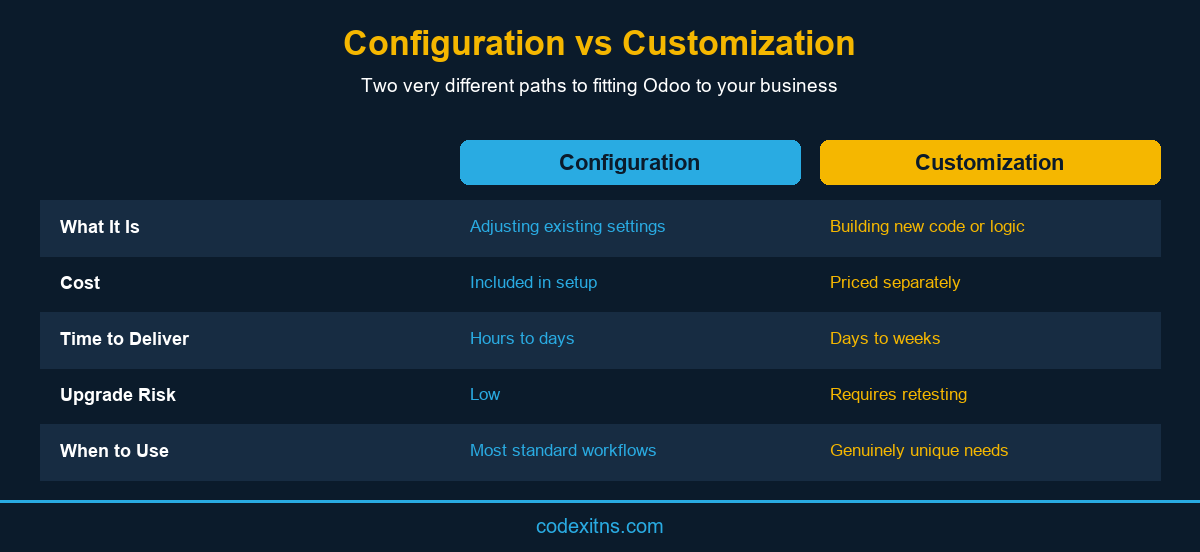
Configuration adjusts existing Odoo settings and is usually included in standard implementation, while customization involves new code and is priced separately.
Most UAE businesses need far less custom development than they initially assume once discovery maps their real workflow gaps.
Over customizing increases both upfront cost and long term maintenance risk, especially around future Odoo version upgrades.
Configuration vs Customization: What's the Difference
Configuration means adjusting settings that already exist inside Odoo, such as approval workflows, VAT rates, user permissions, or report layouts. It requires no new code and is typically included as part of standard implementation. Odoo ERP Customization is different. It means writing new code to add functionality that does not exist natively, whether that is a unique pricing calculation, an industry specific document format, or a workflow with logic Odoo simply was not built to handle by default.
The distinction matters because the two are priced and risked very differently. Configuration is fast, low risk, and usually covered under a standard Odoo consultation and process analysis engagement. Customization requires development time, testing, and ongoing maintenance every time Odoo releases a new version, which is why experienced partners exhaust configuration options first before recommending custom code.
A simple test helps separate the two in practice. If the change you want exists as a toggle, field, or workflow rule already inside Odoo settings, it is configuration. If it requires a developer to write and test new logic that does not exist in the platform today, it is Odoo ERP Customization. Most businesses discover during discovery that far more of their wish list falls into the first category than they originally assumed.
Signs Your Business Actually Needs Odoo Customization
A genuine need for Odoo ERP Customization usually shows up as a specific, repeatable gap rather than a vague sense that the system feels incomplete. If your team has to export data to Excel every week to perform a calculation Odoo cannot do natively, that is a strong signal. If a workflow requires approvals routed in an order specific to your organization that native settings cannot replicate, that is another.
Industry specific requirements are a common legitimate driver. Optical retailers tracking prescriptions alongside inventory, or tailor businesses managing custom measurements per order, often need targeted customization because these workflows fall outside what a general purpose ERP anticipates. Our optical stores and chains solution and the broader guidance in our post on what optical businesses must ask before choosing an ERP both cover this kind of legitimate customization need in more depth.
Scale is another honest signal. A business running a single branch with straightforward sales and inventory flows rarely needs heavy customization. A business managing multiple branches, several legal entities, or complex multi currency trading across the GCC is more likely to hit a genuine limitation that native configuration cannot resolve, which is when Odoo ERP Customization becomes a reasonable investment rather than an unnecessary expense.
Common Types of Odoo ERP Customization
Custom reporting is one of the most frequent Odoo ERP Customization requests, particularly for businesses that need board level dashboards combining data across finance, inventory, and sales in a specific format leadership already expects. Custom development and system integrations also commonly cover connecting Odoo to third party tools such as banking platforms, payment gateways, or ecommerce storefronts that do not have a native connector.
Industry specific document formats are another common category, such as construction project cost reports or trading company customs documentation formatted to match what UAE authorities or client contracts require. Businesses in construction and contracting frequently need this kind of tailored output, as do trading companies managing multi currency invoicing across GCC markets.
Approval workflow logic is a fourth category worth naming separately from basic configuration, since some businesses need multi level, conditional approval chains that go beyond what standard settings support, particularly around procurement above certain value thresholds. This is a legitimate case for custom development, but it should be scoped narrowly around the specific condition that native configuration cannot handle, not rebuilt from scratch.
Risks of Over Customizing Your Odoo Implementation
Every line of custom code is a line that needs retesting when Odoo releases a new version. Businesses that customize heavily in year one often face a difficult choice at upgrade time: pay to rebuild and retest all that custom code, or stay on an older version and slowly fall behind on security patches and new features.
Over customization also tends to happen gradually rather than all at once. A reasonable request in month one becomes a pattern by month six, where every minor friction point gets solved with new code instead of a process change or existing native feature. This is why disciplined Odoo Implementation Services always default to configuration first and treat every customization request as a decision with long term cost, not just a one time development fee.
There is also a hidden knowledge risk. Heavily customized systems often depend on the specific developer or partner who built them understanding undocumented logic. If that relationship ends, a new partner may need significant time just to understand what was built before they can safely make further changes, which adds cost and risk that businesses rarely factor into their original Odoo ERP Customization decision.
How to Scope a Customization Project the Right Way
Start by documenting the actual business problem, not the solution you assume you need. A request that starts as build us a custom report often turns out to be solvable with a configuration change once a partner understands what the report is actually meant to answer. This is exactly the discovery work covered in our guide on Odoo ERP implementation strategies for smooth post go live operations.
Once a genuine customization need is confirmed, ask your Odoo Implementation Partner Dubai for a written scope covering exactly what is being built, how it will be tested, and what happens to that customization during future upgrades, consistent with Odoo's own guidance on customization best practices. Our post on best practices for error free data migration covers a similar discipline worth applying to any custom development work as well.
It also helps to pilot a customization request with a small group of users before rolling it out company wide. This mirrors the phased approach covered in our guide on finding the right ERP software development company, and it catches usability issues while the cost of changing course is still low, rather than after full deployment across every branch.
Conclusion
Odoo ERP Customization is a powerful tool when used for the right reasons, but most UAE businesses need far less of it than they initially assume. Configuration handles more workflows than people expect, and the businesses that exhaust those native options first consistently end up with leaner, more maintainable systems than those who reach for custom code at the first sign of friction.
If you are unsure whether your business needs configuration or genuine customization, contact Codex for a consultation. As an Official Odoo Silver Partner, we scope every request honestly, recommending native configuration wherever it solves the problem before proposing custom development.
Related solution: Odoo ERP for Optical Stores and Chains explains how Codex handles this workflow for UAE businesses.
Running an optical store or chain? Explore the Codex optical ERP solution for prescription records, POS, inventory, branch controls, customer history, and reporting. Explore Odoo ERP for Optical Stores and Chains or talk to Codex for a guided consultation.
Frequently Asked Questions
What is the difference between Odoo configuration and customization?

Configuration adjusts existing settings with no new code, while customization involves writing new code to add functionality that does not exist natively in Odoo.
Does every business need Odoo ERP customization?
No. Most UAE SMEs can meet the majority of their workflow needs through configuration alone, with customization reserved for genuinely unique, repeatable business requirements.
How much does Odoo ERP customization typically cost?
It varies by complexity and is usually priced separately from standard implementation. See our post on ensuring successful ERP deployment for what a well scoped project typically includes.
What industries need the most Odoo customization in the UAE?
Optical retail, tailor management, and specialized manufacturing tend to need more customization, similar to the needs covered in our manufacturing ERP software guide, since their workflows fall outside standard ERP assumptions more often than trading or general services.
Does customization make future Odoo upgrades harder?
Yes. Custom code typically needs retesting and sometimes rebuilding when Odoo releases new versions, which is why disciplined post go live support and maintenance reduces long term maintenance cost.
Can I add Odoo ERP customization after my initial implementation?
Yes. Many businesses start with core configuration through full cycle Odoo implementation and add targeted customization later once real usage reveals a genuine, repeatable gap.
How do I know if a request needs customization or just configuration?
Document the underlying business problem first. Many requests that sound like customization are solvable through configuration once a partner understands the actual goal behind the request.
What is a common mistake businesses make with Odoo customization?
Approving small custom requests gradually without tracking cumulative cost and upgrade risk. Our post on 10 benefits of working with an experienced Odoo ERP company covers how a disciplined partner avoids this pattern.
Can Odoo customization integrate with existing banking or payment tools?
Yes. Custom development and system integrations with banking, payment gateways, and ecommerce platforms are among the most common and genuinely useful types of Odoo ERP customization for UAE businesses.
Where can I get an honest assessment of my Odoo customization needs?
Codex evaluates every request against native configuration first. Visit our About page to learn more about our approach as a UAE Odoo Silver Partner.