The Complete Guide to Odoo ERP Implementation in the UAE (2026 Edition)
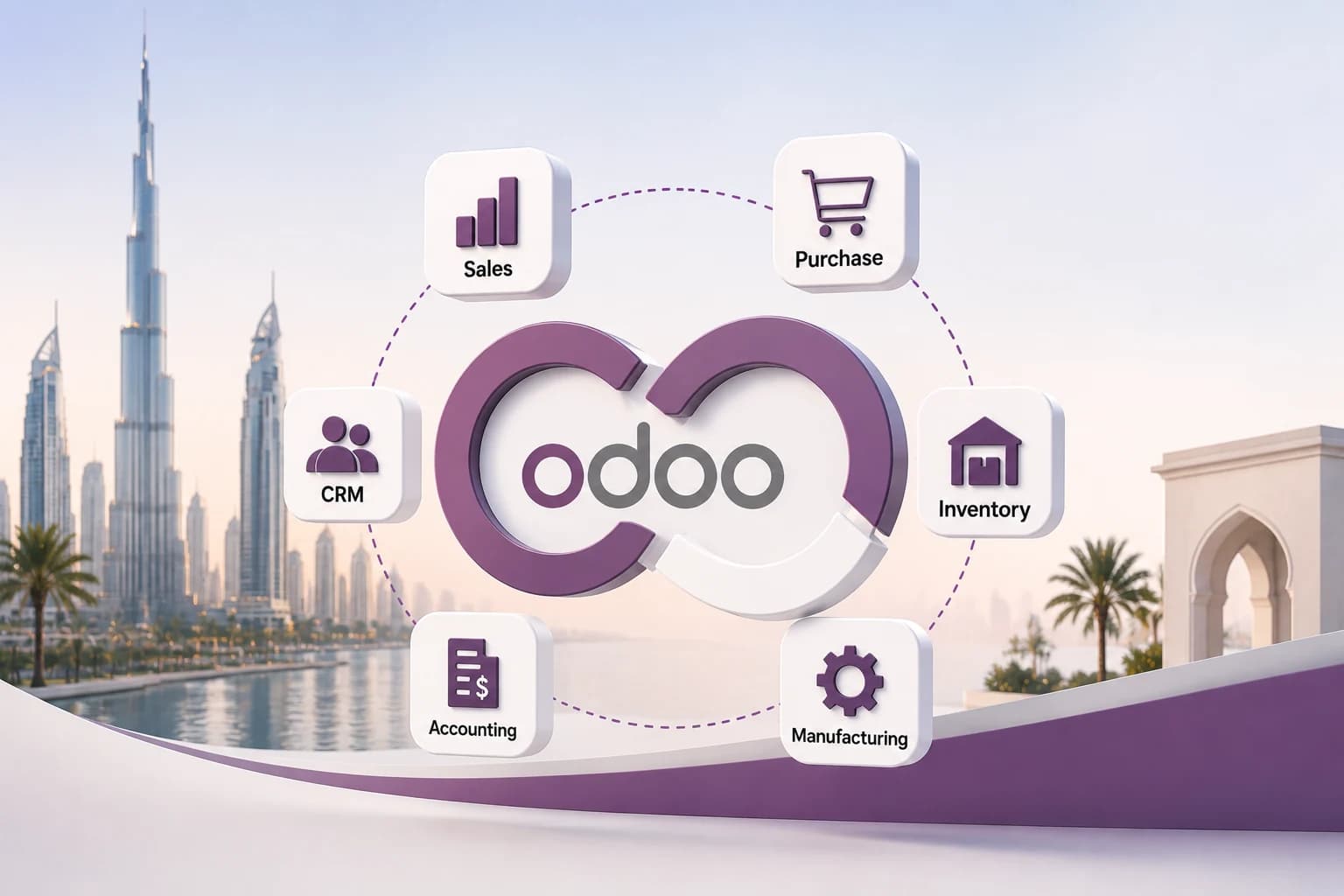 Odoo
OdooThe Complete Guide to Odoo ERP Implementation in the UAE (2026 Edition)
Choosing and implementing an ERP system is one of the biggest operational decisions a UAE business will make this year, and Odoo ERP UAE implementations have become the most common choice among growing companies across Dubai, Abu Dhabi, and Sharjah. This guide walks through everything a business owner or operations leader needs to know before starting an Odoo project in 2026, from what the platform actually does to how much it costs, how long implementation takes, and how to choose a partner who will not leave you stranded after go live.
Whether you are comparing Odoo ERP UAE against traditional enterprise platforms or evaluating your first ERP system altogether, this guide covers the full implementation journey in one place. Use the sections below to jump to what matters most for your business, or read start to finish for a complete picture of what a modern UAE ERP rollout looks like.
This is not a marketing overview. It is a practical reference built from real implementation experience across trading, construction, contracting, optical retail, and service businesses in the UAE. By the end, you should be able to walk into a conversation with any Odoo ERP UAE provider and know exactly what questions to ask, what a fair quote looks like, and what red flags to watch for before signing a contract.
Key Takeaways
Odoo ERP UAE implementations typically take six to sixteen weeks depending on module count, data volume, and customization needs.
Modular pricing lets businesses start with core finance and inventory modules, then expand into CRM, HR, and manufacturing as they grow.
Native UAE VAT compliance and Arabic language support make Odoo a stronger regional fit than many international ERP platforms.
The single biggest driver of implementation success is choosing an experienced local partner who understands UAE business workflows, not just the software.
Why UAE Businesses Are Investing in Odoo ERP in 2026
The UAE's push toward digital transformation across every sector has made manual, spreadsheet driven operations a competitive disadvantage rather than a workable shortcut. Businesses that delay ERP adoption typically lose ground on reporting speed, inventory accuracy, and VAT compliance, all of which affect how quickly leadership can make decisions with confidence. Odoo ERP UAE adoption has accelerated specifically because it solves these problems without the enterprise price tag that kept ERP out of reach for smaller companies a decade ago.
Government backed digital initiatives across the UAE, alongside stricter VAT reporting expectations from the Federal Tax Authority, have also pushed businesses toward systems that keep clean, auditable financial records by default. Companies exploring ERP software solutions UAE providers offer consistently point to compliance and operational visibility as the two biggest reasons they finally moved off legacy tools in the past two years.
Market competition is the third driver. As more UAE businesses digitize, customers increasingly expect faster quotes, accurate delivery timelines, and self service order tracking, all of which depend on backend systems that talk to each other in real time. A business still running separate tools for inventory, invoicing, and customer records simply cannot match the response speed of a competitor running a unified Odoo ERP UAE deployment, and that gap becomes more visible to customers every year the legacy setup stays in place.
Economic diversification across the UAE's broader economy has also expanded the range of industries adopting Odoo ERP UAE solutions beyond the trading and logistics sectors that led early adoption. Construction, healthcare adjacent services, and specialty retail businesses are now investing in ERP at the same rate as larger trading houses did five years ago, which has pushed partner ecosystems and localized support options to mature significantly across the region.
What Is Odoo ERP and How Does It Work
Odoo is an open architecture business management platform that brings together the applications a company needs to run daily operations, including accounting, inventory, sales, CRM, HR, and manufacturing, inside one connected system. Rather than buying and integrating separate tools for each function, businesses run everything from a single login, with data flowing automatically between departments instead of being re entered manually at each handoff.
This matters more than it sounds. In a disconnected setup, a sales order placed in one tool has to be manually copied into an inventory system, then again into accounting for invoicing. Each manual step is a chance for human error, and each delay slows down the customer experience. Odoo eliminates those handoffs by design, which is a core reason Odoo ERP UAE adoption has grown fastest among businesses with multiple departments that previously operated on separate software.
Understanding this connected structure also explains why Odoo ERP UAE projects are scoped by workflow rather than by individual feature. A partner configuring the platform correctly maps how information should flow from sales to inventory to finance before touching a single settings screen, because getting that flow right is what actually produces the efficiency gains businesses are paying for.
Modular Architecture Explained
Every Odoo deployment is built from individual modules, called apps, that a business activates based on need. A trading company might start with sales, inventory, and accounting, while a service business might prioritize CRM and project management instead. This modular structure is central to why so many companies moving to enterprise resource planning software for the first time choose Odoo over rigid, all in one suites that force a full commitment on day one. New modules can be activated later without disrupting modules already in production, which lets a business grow into the platform over several years rather than overbuilding on day one.
Open Source Core vs Enterprise Edition
Odoo ships in two editions. The community edition is open source and free to self host, while the enterprise edition adds advanced features, official support, and cloud hosting through Odoo directly. Most UAE businesses working with a certified partner choose the enterprise edition because it includes UAE localization packages, ongoing updates, and the support infrastructure a growing business actually needs rather than has time to build in house.
Self hosting the community edition can look cheaper on paper, but it shifts server maintenance, security patching, and localization work onto the business itself. For most Odoo ERP UAE companies without a dedicated in house development team, the enterprise edition's included support ends up costing less overall once staff time and downtime risk are factored into the comparison.
Core Odoo Modules for UAE Businesses
Not every business needs every module, but a handful of core apps form the foundation of nearly every successful Odoo ERP UAE implementation in the region. Understanding what each one actually does helps leadership scope a realistic first phase instead of guessing at what the project should include.
A useful exercise before the first consultation is listing every spreadsheet or standalone tool your team currently relies on, then matching each one against an Odoo module. This quickly reveals which modules deliver the fastest return and which can safely wait for a later phase, which keeps the initial scope realistic instead of trying to replace every tool at once.
Finance, Accounting, and VAT Compliance
The accounting module handles invoicing, expense tracking, bank reconciliation, and native UAE VAT reporting. Businesses no longer need a separate compliance tool bolted onto their books, which is one of the clearest advantages Odoo holds over platforms built for markets without a VAT requirement. Multi currency support also matters for UAE businesses trading regionally, since invoices and reports can reconcile automatically across AED and other GCC currencies without manual conversion work.
Inventory, Sales, and CRM
The inventory module gives real time stock visibility across multiple warehouses and branches, a must for trading and retail businesses. Paired with Odoo CRM, sales teams get one pipeline view instead of chasing leads across email and spreadsheets, and orders sync directly into inventory and accounting without manual re entry. This connection between modules is what actually delivers the efficiency gain, not any single module on its own.
For Odoo ERP UAE businesses exploring their options in more depth, our dedicated post on inventory management software walks through how stock accuracy directly affects both customer satisfaction and working capital tied up in excess inventory.
HR, Payroll, and Employee Self Service
The Odoo HR module combined with the HR and employee self service app gives staff direct access to leave requests, attendance, and payslips, reducing the administrative load that typically falls on a small HR team as headcount grows.
For businesses in the ten to fifty employee range, this module alone often justifies the broader Odoo ERP UAE investment, since it removes the spreadsheet based leave tracking and manual payroll calculations that consume disproportionate HR time relative to headcount. Any serious Odoo ERP UAE scoping conversation should include HR early, not as an afterthought once other modules are already stable.
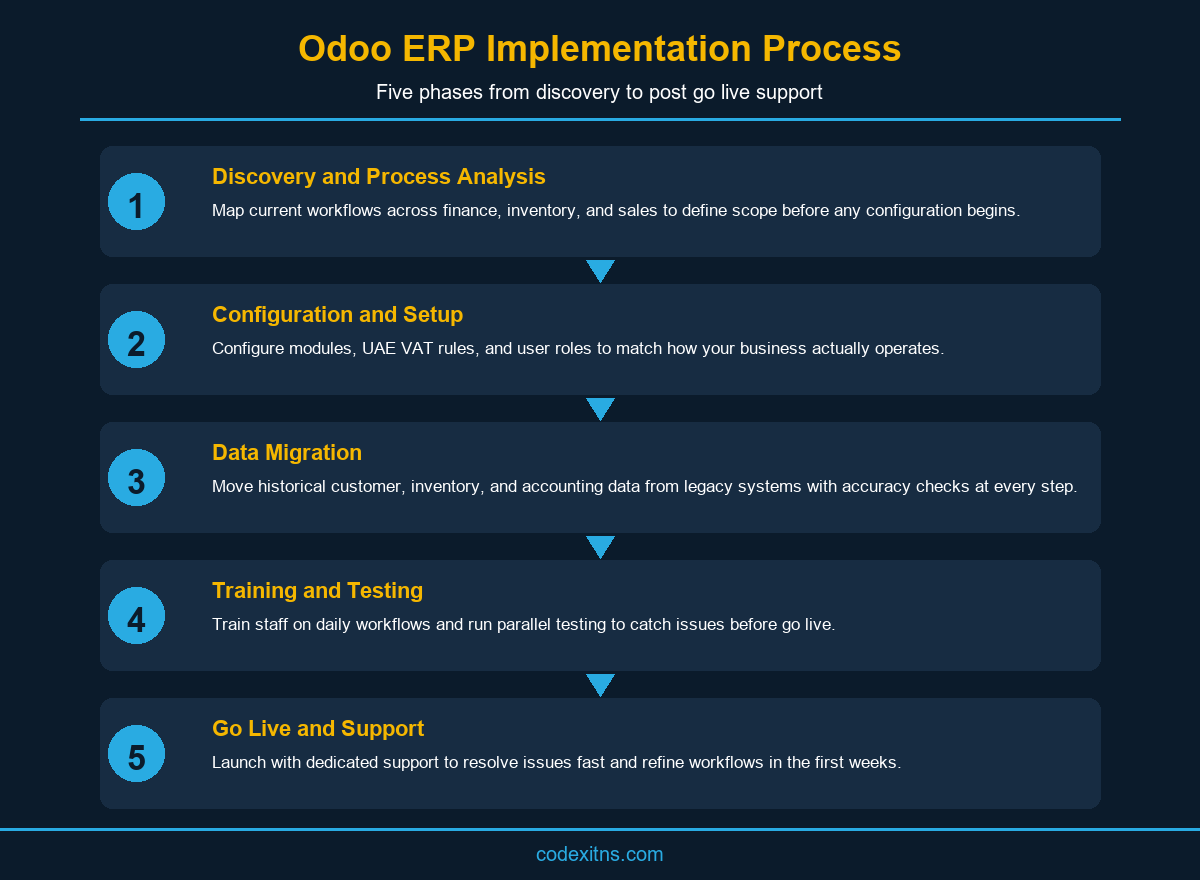
Odoo ERP Implementation Process Step by Step
A structured implementation process is the single biggest factor separating successful rollouts from ones that stall or run over budget. The stages below reflect how experienced partners approach a typical Odoo ERP UAE project from first conversation to post go live support.
Discovery, Configuration, and Migration
Every project should begin with an Odoo consultation and process analysis phase that documents current workflows before any configuration starts. Skipping this step is the most common reason implementations run over budget, because teams end up reconfiguring modules mid project once gaps in the original scope surface. Configuration and data migration follow, with historical records moved from legacy systems and validated against source data to prevent reporting errors after launch.
Training, Go Live, and Ongoing Support
Staff training determines how quickly a business actually realizes the value of its new system. Rushed training leads to workarounds and shadow spreadsheets that undermine the entire project. After go live, post go live support and maintenance keeps the system running smoothly as real world usage surfaces edge cases that were not obvious during testing. See our guide on strategies for smooth post go live operations for a deeper breakdown of this stage.
Many businesses underestimate how much post go live support they will actually need in the first ninety days. Real usage patterns always surface questions that discovery workshops did not anticipate, and a partner who budgets support hours generously into that early window tends to see far higher long term module adoption than one who treats go live as the finish line.
Odoo ERP Cost in the UAE: What to Expect
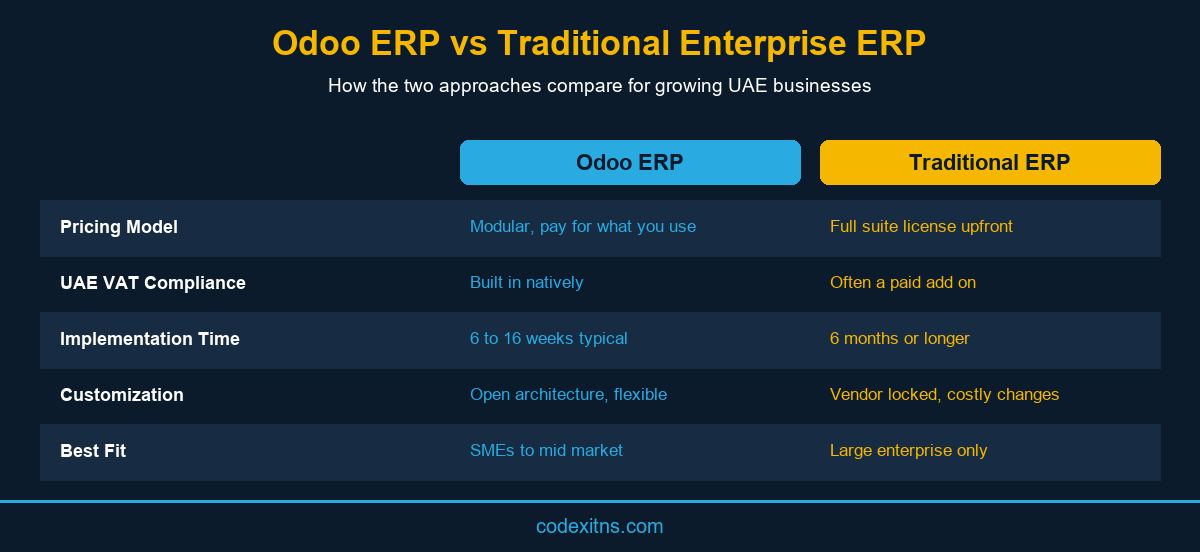
Cost is usually the first question business owners ask about an Odoo ERP UAE project, and the honest answer is that it depends heavily on module count, user seats, data complexity, and customization scope. What matters more than a fixed number is understanding the cost structure: licensing, implementation services, data migration, training, and ongoing support are typically priced separately, which lets businesses control spend by scoping the project carefully rather than buying a bundled package with features they will never use.
Compared with traditional ERP companies in Dubai offering enterprise platforms built for large multinational operations, Odoo's modular pricing consistently comes out ahead for SMEs and mid market businesses. A ten person trading company and a two hundred person contracting firm can both run Odoo profitably because each only pays for the scope it actually uses, not a flat enterprise license fee.
It also helps to think about cost in three buckets: one time implementation costs covering configuration and data migration, recurring licensing tied to user seats and modules activated, and ongoing support costs for maintenance and future customization. Businesses that budget for all three from the start avoid the common surprise of an accurate implementation quote followed by an underestimated year one support bill.
A useful way to evaluate any quote is to ask what happens in year two. Some providers price implementation aggressively low and recover margin through expensive change requests later. A transparent Odoo ERP UAE partner should be able to explain their support pricing model upfront, before the contract is signed, not after the first change request arrives.
Choosing the Right Odoo Implementation Partner
Software alone does not guarantee a successful implementation. The partner configuring and supporting the system matters just as much, if not more. Look for a certified partner with a documented history of successful ERP deployment in your industry, transparent pricing, and a support model that continues after go live rather than ending the moment the contract is signed.
Our guide on choosing your Odoo partner in Dubai covers the specific questions worth asking before signing, and our article on why your business needs an Odoo partner explains the risk of attempting a self managed implementation without local expertise.
Partner tier is also worth understanding. Odoo certifies partners at Silver and Gold levels based on training, project volume, and customer satisfaction scores. A higher tier is not automatically the right fit for every business, but it does signal a track record worth verifying through case studies and direct references before committing budget to a multi month engagement.
Before signing with any provider, ask for at least two references from businesses of similar size in your industry, request a written scope document rather than a verbal estimate, and confirm exactly what is included in the first ninety days of post go live support. A partner who hesitates on any of these three requests is worth reconsidering before committing to a full Odoo ERP UAE engagement.
Common Implementation Challenges and How to Avoid Them
Most failed or delayed ERP projects trace back to a handful of recurring mistakes: unclear scope, rushed data migration, insufficient staff training, and no plan for support after launch. Businesses that treat implementation as a one time project rather than an ongoing process are the ones most likely to abandon modules within the first year because nobody owned the system after the consultants left.
Our best practices guide on error free data migration with Odoo implementation services addresses the most technical of these risks directly, while our article on finding the right ERP software development company covers how to vet a partner's process before committing budget.
Change resistance from staff is another underestimated risk. Employees who have used the same spreadsheet for years will not automatically embrace a new system just because leadership approved the budget. Involving department leads early in the discovery phase, and giving them a role in configuration decisions, consistently produces smoother adoption than a top down rollout announced only once the system is ready to launch.
Scope creep is the final risk worth naming directly. It is tempting to add just one more customization mid project once staff see what the system can do, but every unplanned addition pushes back the timeline and increases cost. The most successful Odoo ERP UAE rollouts lock scope after discovery, ship the agreed first phase, and treat every new idea as a candidate for phase two rather than a reason to reopen configuration that is already stable. A disciplined Odoo ERP UAE partner will say no to scope changes mid sprint just as often as they say yes, and that discipline is usually a good sign, not a red flag.
Odoo ERP by Industry: UAE Use Cases
Odoo's value looks different depending on industry. Construction and contracting firms use it to track project costing, procurement, and payroll across multiple active sites, a use case covered in depth in our construction ERP UAE guide. Manufacturing businesses lean on it for supply chain visibility, as explored in our post on manufacturing ERP software for small and medium businesses.
Trading and van sales operations benefit from real time inventory across branches, while optical stores and chains use Odoo for prescription tracking alongside point of sale, a use case detailed in our post on what optical businesses must ask before choosing an ERP. Service oriented SMEs also see strong results, as shown in how Odoo ERP for small business enables UAE SMEs to integrate CRM and service operations in one platform.
What all of these industries share is a common pattern: the businesses that get the most value from Odoo ERP UAE adoption are the ones that configure the platform around their specific operational reality rather than accepting a generic default setup. That is the core argument for working with a partner who has deployed the platform in your industry before, rather than a generalist implementer learning your sector for the first time on your project.
Conclusion
Odoo ERP UAE implementations succeed when businesses treat the project as a structured process rather than a single software purchase. Understanding the modules available, the realistic cost structure, the implementation timeline, and what to look for in a partner puts you in a far stronger position than businesses that jump straight to configuration without a plan. The UAE's push toward digital operations and stricter VAT compliance is not slowing down, and companies that modernize now gain a real advantage over competitors still running on spreadsheets.
The businesses that regret their Odoo ERP UAE investment are almost never the ones who chose the wrong software. They are the ones who skipped discovery, rushed training, or picked a partner based on price alone without checking whether ongoing support was actually included. Avoid those three mistakes and the odds of a successful implementation shift heavily in your favor.
If you are ready to plan your own Odoo ERP UAE implementation, contact Codex for a consultation. As an Official Odoo Silver Partner supporting more than 100 UAE businesses, we build implementation roadmaps around your actual operations, not a generic template. You can also explore Odoo's own platform overview at odoo.com to see the full scope of applications available.
Related solution: Odoo Van Sales Solution explains how Codex handles this workflow for UAE businesses.
Need a van sales rollout for your field team? Review the Codex van sales solution for route planning, mobile ordering, stock control, invoicing, payments, and daily reporting. Explore Odoo Van Sales Solution or talk to Codex for a guided consultation.
Frequently Asked Questions
How long does an Odoo ERP UAE implementation take?

Most UAE implementations take six to sixteen weeks depending on module count, data complexity, and customization scope, with core finance and inventory modules typically going live first.
What is the difference between Odoo community and enterprise edition?
Community edition is free and open source, while enterprise edition adds official support, cloud hosting, and UAE localization packages that most businesses need for VAT compliant operations.
How much does Odoo ERP cost for a UAE business?
Costs vary by module count, user seats, and customization, typically ranging from a few thousand to tens of thousands of dirhams. A consultation gives an accurate estimate for your scope.
Does Odoo support UAE VAT and Arabic language requirements?
Yes. Odoo includes native UAE VAT calculation and reporting along with Arabic language support, which reduces the need for costly third party compliance add ons.
Can Odoo ERP replace multiple existing business tools?
Yes. Odoo consolidates accounting, inventory, CRM, sales, and HR into one connected platform, eliminating the duplicate data entry that comes from running separate disconnected tools.
What industries in the UAE benefit most from Odoo ERP?
Trading, construction, contracting, manufacturing, optical retail, and service based businesses see the fastest returns because Odoo's modules map directly onto how these industries operate day to day.
Is Odoo ERP suitable for a business just starting to scale?
Yes. Modular pricing lets a growing business start with core modules and add functionality later, which avoids the large upfront investment traditional ERP platforms typically require.
What happens if an Odoo implementation goes over budget?
Most budget overruns trace back to unclear scope or skipped discovery phases. Working with a partner who documents workflows upfront through Odoo consultation and process analysis significantly reduces this risk.
How do I choose between different Odoo partners in the UAE?
Compare partner tier, industry experience, and whether post go live support is included in the contract. Our 10 benefits of working with an experienced Odoo ERP company post covers this in detail.
Where can I get a customized Odoo ERP UAE implementation plan?
Codex offers a free consultation to map your current workflows and build a realistic implementation roadmap. Visit our About page to learn more about our track record as an Odoo Silver Partner.