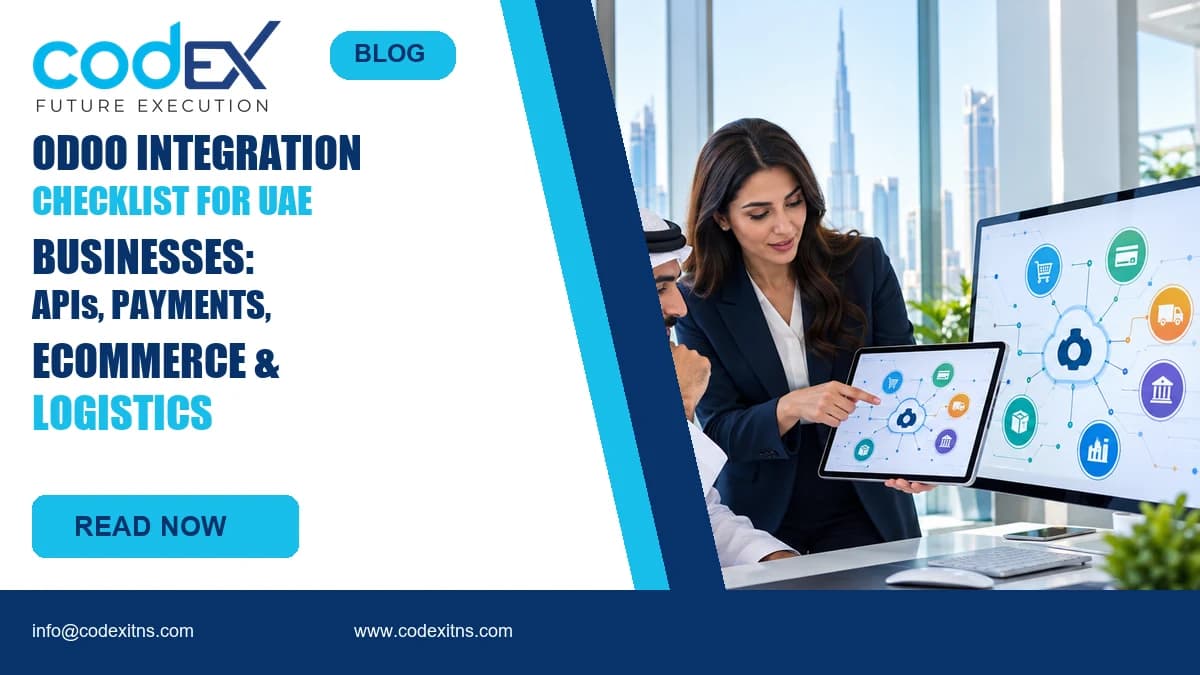
Odoo Integration Checklist for UAE Businesses: APIs, Payments, Ecommerce and Logistics
 General
By Mahesh
Evaluating odoo integration in Dubai or across the UAE requires a clear checklist before approving connectors or custom builds. Define the business process, system owner, data rules, security model, testing method, and support structure first; otherwise, you risk duplicate records, failed syncs, and manual work across sales, finance, and delivery.
This means answering three questions early: what process must connect, which system serves as the source of truth, and what occurs automatically versus via manual approval. For UAE companies, this typically encompasses online orders, 5% VAT handling, payment capture, inventory reservation, courier dispatch, and accounting entries within a unified workflow.
An integration checklist is a structured pre-project review covering architecture, data ownership, authentication, exception handling, testing, upgrade risks, and support. It prevents businesses from treating integrations as simple API tasks when they are actually cross-functional workflow designs.
Why a checklist matters before connecting systems
Most integration issues stem from assuming systems handle customer, product, tax, price, or payment data identically. Odoo maintains structured item masters, units of measure, warehouses, analytic accounts, and approval rules that external platforms may not natively support.
Common connected platforms in the UAE include Shopify, WooCommerce, Telr, Network International, Stripe UAE, Tap Payments, Aramex, and bank reconciliation feeds. Other requirements include CRM forms, third-party POS, MES, barcode tools, and service platforms requiring one unified transaction flow.
A checklist forces decision-makers to classify integrations by business criticality. A failed lead sync is inconvenient; a failed payment posting, stock deduction, or shipment creation directly impacts cash flow and delivery. This distinction dictates monitoring, retry logic, approval controls, and support designs.
If mapping wider ERP scope, do so alongside Odoo consultation and process analysis rather than adding interfaces later. Integrations must support the target operating model, not patch over unclear processes.
Define process, owner and source of truth first
Process clarity precedes connector selection. Determine which event triggers a sync, who owns the record, and the acceptable processing delay. For example, when a web order is paid, decide if Odoo should automatically generate sales orders, reserve stock, create invoices, and request shipments, or if internal reviews are required first.
Assign a source of truth for every master record and transaction. Customer profile data may originate in ecommerce, but credit terms and accounting dimensions belong in Odoo. Product images can stay on Shopify, while SKUs, availability, costs, tax setups, and reorder rules remain inside the ERP.
Key workshop decisions
- Orders: Sync all confirmed checkouts or only paid orders?
- Inventory: Push stock in real time, on schedule, or after warehouse validation?
- Payments: Send settlement status only, or include detailed refunds and chargebacks?
- Delivery: Automate shipment creation or require manual picking confirmation?
- Finance: Which system posts final accounting entries and applies VAT rules?
Departmental ownership is equally vital. Sales owns opportunities; operations handles stock and fulfillment exceptions; finance manages reconciliation and tax mapping; IT oversees credentials, logs, and change controls. Clear ownership prevents unresolved operational errors.
Aligning this planning with full-cycle Odoo implementation services ensures modules, approvals, and integrations function together seamlessly.
Choose the right connection method
Select direct API connections for narrow workflows with stable endpoints and minimal data transformation, such as sending delivery orders from Odoo to a courier API for tracking updates.
Use middleware for multi-system environments requiring field transformations, queue management, or rate-limiting. Middleware simplifies version management by centralizing the transformation layer when updating ERP, CRM, and shipping tools simultaneously.
Opt for custom development when commercial processes are unique, prebuilt connectors lack data model support, or UAE-specific logic is needed—such as multi-branch stock allocation or payment settlement mapping by acquirer batch. Our custom development and system integrations work begins with a fit assessment to verify if custom code is necessary.
| Method | Best fit | Main advantage | Main risk |
|---|---|---|---|
| Direct API | Simple 1-to-1 workflows | Lower complexity and faster execution | Dependency on API changes |
| Middleware | Multi-system architectures | Centralized monitoring and queuing | Additional platform layer |
| Custom build | Unique operational logic | Exact fit for business rules | Requires documentation and upgrade reviews |
Always review authentication methods, webhooks, rate limits, timeouts, retries, and versioning policies before finalizing a strategy.
Data rules, sync frequency and exception handling
Odoo syncs inventory, accounting, purchasing, and sales modules with external channels effectively only when data models are clean. This requires aligning SKUs, units of measure, locations, tax tags, pricelists, and transaction statuses.
For inventory, determine whether available quantity, on-hand quantity, or available-to-promise logic is exposed online. Wholesalers managing reserved stock need different configurations than retailers selling physical branch inventory.
For finance, define how sales, refunds, fees, and VAT map into accounting. UAE operations require multi-currency handling and local 5% VAT mapping. According to the UAE Federal Tax Authority, VAT applies at a standard rate of 5%. ERP setups must capture tax codes and maintain complete audit trails across invoices, credit notes, and payments.
Essential operational controls
- Use unique external IDs to prevent duplicate order or payment processing.
- Define sync frequencies: real time for stock and payments; scheduled for low-priority data.
- Log inbound and outbound events with timestamps, payload details, and execution results.
- Establish exception queues for manual intervention instead of allowing silent failures.
Review module dependencies using our guide on what to implement first in Odoo for UAE businesses to ensure warehouse and finance structures are ready.
UAE-specific interface requirements
When connecting local payment gateways like Telr, Network International, or Tap, confirm requirements for hosted redirections, embedded checkouts, tokenization, refund events, and settlement files. Ensure gateways support retry callbacks for failed notifications.
For ecommerce connectors, verify support for order imports, stock updates, price syncs, customer matching, discounts, coupons, shipping methods, and refunds. Multi-currency merchants must clarify base currencies, settlement currencies, and exchange variance handling in accounting.
For logistics (e.g., Aramex), integrations require waybill generation, pickup requests, tracking updates, and delivery status returns. Confirm support for cash-on-delivery fields, address validation, and webhook tracking.
Banking integrations should streamline statement imports, posting frequencies, and reconciliation. Review interface readiness alongside wider operational decisions using our Odoo implementation checklist for UAE go-live decisions.
Security, testing and partner evaluation
Key project risks include credential mismanagement, unclear ownership, inadequate testing, upgrade breakage, and missing support models. Secure integrations using API keys, OAuth, role-based access, credential rotation, and separate sandbox and production environments.
Testing must be scenario-based. Validate complete end-to-end flows: paid orders, payment callback failures, partial shipments, refunds, duplicate webhooks, out-of-stock items, and delayed bank settlements. Confirm both system data accuracy and downstream accounting impacts.
Define post-go-live support early. Identify alert recipients, automated retry rules, user intervention steps, and log review procedures. Partnering with an experienced Odoo partner in the UAE ensures system objects and operational processes align properly.
Before signing, request architectural diagrams, sample payloads, exception handling plans, test cases, and upgrade support terms. Contact CodeEX to review existing interfaces or scope new integration projects.
Related Articles
- Why Odoo Erp Is The Preferred Choice For Growing Businesses In Dubai
- Best Erp Software Dubai Checklist Uae
- Inventory Management Software For Small Businesses Uae
Odoo Integration Checklist for UAE Businesses
A practical UAE guide to odoo integration across APIs, payments, ecommerce, logistics, testing, security and long-term support.
Frequently Asked Questions
What systems are most commonly integrated with Odoo in UAE businesses?

How do you decide whether to use APIs, middleware, or custom development?
Can Odoo integrate with UAE payment gateways, ecommerce platforms, and courier providers?
What are the main risks in Odoo integration projects and how can they be reduced?
What should a business ask an Odoo integration partner before starting the project?