Odoo Modules Guide for UAE Businesses: What to Implement First
 General
Odoo Modules Guide for UAE Businesses: What to Implement First
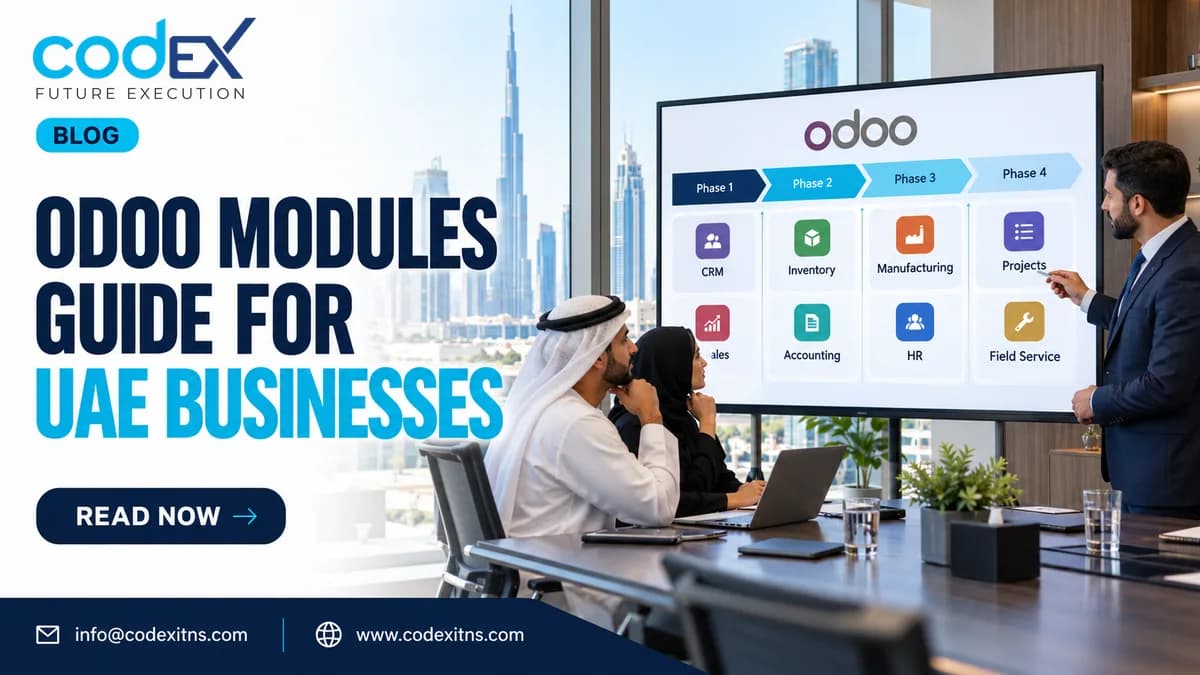
Choosing the right odoo modules is less about activating everything at once and more about sequencing the modules that control cash flow, stock, customer orders, purchasing, projects, and people in the right order. For most UAE SMEs, the best phase-one scope is the smallest connected set of modules that can run the business reliably from transaction capture to reporting.
In practice, that means starting from business model, process dependencies, and data readiness rather than a fixed bundle. This guide shows which Odoo modules to implement first, when to begin with accounting versus inventory, and how rollout priorities differ for trading, manufacturing, service, and project businesses.
1. Why phase-one Odoo module selection matters
What is an Odoo module? An Odoo module is a functional application inside the ERP, such as Accounting, Sales, Inventory, Purchase, Manufacturing, Projects, HR, or Payroll. Modules share one database, so the decision is not just which apps to enable, but which business transactions must flow together on day one.
Phase-one choices matter because early module scope determines master data structure, approval design, reporting logic, user permissions, and migration effort. A UAE company that starts with CRM and quotations can go live quickly, but if stock valuation, supplier bills, and VAT reporting are immediate priorities, that lightweight phase will not solve the core control problem.
Ask the direct question: What process is currently causing the most operational risk? If it is delayed invoicing, phase one may center on Sales, Accounting, and approvals. If it is stock mismatch across branches, Inventory and Purchase move earlier. If it is uncontrolled job costing, Projects, Purchases, and Accounting need tighter integration from the start.
A common mistake is choosing modules based on department preference rather than transaction dependency. Sales teams may want CRM first, warehouse teams may want barcode flows first, and HR may request self-service first; but the better decision is to map the sequence that creates one auditable operational backbone. That is why many companies work with an Odoo Partner UAE to define a phased scope before configuration begins.
2. How to decide what to implement first
Use a three-part test: business model, dependency, and data readiness. Business model tells you which transaction stream is most critical. Dependency tells you which modules must exist before another module can produce reliable outputs. Data readiness tells you whether your item master, chart of accounts, customer records, BOMs, employee data, or open balances are clean enough for go-live.
Ask three buyer questions in order. Are we stock-led, service-led, or project-led? Which transaction must post correctly from day one? Which master data can we trust today? The answers usually narrow phase one quickly.
Concise module dependency table
| Module | Implement early when | Depends mainly on | Typical UAE SME caution |
|---|---|---|---|
| Accounting | Finance control and statutory reporting are urgent | Chart of accounts, taxes, opening balances | Define VAT treatment and approval rules before migration |
| Sales | Quotation-to-order flow is inconsistent | Customers, products, price lists | Clean customer terms and sales team ownership |
| Purchase | Spend control and supplier approvals are weak | Vendors, products, approval matrix | Standardize vendor names and payment terms |
| Inventory | Stock accuracy affects sales or production | Items, units of measure, locations | Count opening stock and rationalize item codes |
| Manufacturing | BOMs and work orders drive cost and delivery | Inventory, BOMs, routings | Do not go live with incomplete BOM structures |
| Projects/Field Service | Revenue depends on jobs, tasks, or site work | Customers, services, costing rules | Clarify timesheet, expense, and billing logic first |
Practical tip: if open data is unreliable, shorten phase one rather than forcing every department into go-live. A smaller clean scope creates better adoption than a wide launch built on weak masters. For businesses planning a wider roadmap, Full-Cycle Odoo Implementation is usually the safer model because dependencies can be sequenced from discovery through support.
3. The typical phase-one foundation: Accounting, CRM, Sales, Purchase, or Inventory?
There is no universal first module, but there is a typical foundation. For many UAE SMEs, phase one starts with Accounting plus the upstream modules that feed financial control: Sales, Purchase, and sometimes Inventory. This creates an operational chain from quotation or purchase request through invoice, bill, payment, and management reporting.
Should you start with Accounting or Inventory? Start with Accounting first when the business already has acceptable stock control but weak reporting, collections visibility, or expense discipline. Start with Inventory first when stock errors are causing missed sales, wrong purchasing, branch transfer confusion, or unreliable landed-cost visibility. In product businesses, Inventory often moves into phase one because accounting accuracy depends on stock transactions being recorded correctly.
CRM belongs in phase one when lead management, follow-up ownership, and quotation conversion are immediate sales problems. But CRM alone rarely solves the operating issue unless it connects to Sales, approvals, and invoicing. For this reason, a practical phase-one package for many distributors is Sales, Purchase, Inventory, and Accounting rather than standalone CRM.
One common mistake is treating Odoo like a menu of independent apps. In reality, the phase-one foundation should follow transaction flow. If your team is evaluating stock-led operations, this guide on inventory management software for small businesses in the UAE is useful because it highlights the operational controls that usually justify moving Inventory earlier in the roadmap.
4. Recommended rollout examples by business model
Trading and distribution: Phase one usually includes Sales, Purchase, Inventory, and Accounting. These companies need item master discipline, warehouse locations, reorder logic, customer price lists, vendor terms, and receivable/payable visibility before they add advanced CRM or HR layers. Phase two commonly adds barcode, batch or serial logic where relevant, multi-branch controls, and management dashboards.
Manufacturing: Phase one often starts with Inventory, Purchase, Accounting, and a controlled Manufacturing scope only after BOMs, routings, and units of measure are validated. If BOM quality is weak, many manufacturers go live first on procurement, stock, and finance, then add MRP, work orders, subcontracting, or quality steps in phase two. This avoids production reporting based on incomplete structures.
Service businesses: Phase one usually centers on CRM, Sales, Accounting, and service delivery tracking, because the core problem is often quotation-to-invoice delay rather than stock. If technicians, contracts, or visits drive revenue, Project or Field Service may enter earlier than Inventory. For service-led SMEs comparing options, CodeEX also covers workflow needs on its service-oriented business solutions page.
Project and contracting businesses: Phase one should focus on job costing, procurement, supplier bills, customer invoices, retention logic where applicable, and project budget visibility. Projects can technically start early, but only if cost codes, budget structure, and approval paths are clear. Practical tip: do not launch project costing before finance and procurement agree on how every committed and actual cost will be tagged.
5. When to add HR, Payroll, Projects, Field Service, and advanced modules
Advanced modules should be added when the underlying transaction engine is stable. That usually means users are posting sales orders, purchase orders, receipts, bills, invoices, and payments correctly, and core reports are trusted. Once that baseline exists, HR, Payroll, Projects, Field Service, Manufacturing depth, maintenance, or industry workflows can be layered with far less rework.
Can HR and Payroll be added after core ERP go-live? Yes, and for many UAE SMEs that is the better path. Payroll depends on clean employee masters, contracts, attendance or leave rules, earnings and deduction structures, approval workflows, and accounting integration. If the company wants a connected people workflow later, CodeEX provides both an HR module overview and a dedicated payroll and WPS software solution for the UAE that can be planned as a second or third phase.
Another direct buyer question is: What data should be cleaned before implementing Odoo modules? At minimum, clean customer and vendor masters, item codes, units of measure, tax settings, chart of accounts, opening balances, outstanding receivables and payables, BOMs where relevant, employee records for HR phases, and document numbering rules. If duplicate masters remain, your reporting problem simply moves from spreadsheets into ERP.
The final mistake to avoid is over-scoping phase one because the software can technically do more. A sound roadmap defines what must go live, what can wait, and what needs workshop validation. If you are comparing options between an internal team and an implementation partner, this article on why growing businesses in Dubai choose Odoo provides useful context for roadmap planning.
Related Articles
- Odoo Erp Implementation Services What Optical Businesses Must Ask Before Choosing An Erp
- Inventory Management Software For Small Businesses Uae
- Odoo Hr Module Guide How To Streamline Hr Processes
- Why Odoo Erp Is The Preferred Choice For Growing Businesses In Dubai
- The Complete Guide To Odoo Erp Implementation In The Uae 2026 Edition
- Manufacturing Erp Software Dubai For Small And Medium Businesses
Odoo Modules Guide for UAE Businesses
Learn which odoo modules UAE businesses should implement first with a phased roadmap for trading, manufacturing, service and project firms.
Related solution: Field Service and AMC Management Software explains how Codex handles this workflow for UAE businesses.
Planning AMC or field service operations? See how Codex connects service contracts, technician visits, renewals, spare parts, and invoicing in one Odoo workflow. Explore Field Service and AMC Management Software or talk to Codex for a guided consultation.
Frequently Asked Questions
Which Odoo modules should a UAE SME implement first?

Should we start Odoo with Accounting or Inventory?
How do trading and manufacturing companies choose different rollout phases?
What data should be cleaned before implementing Odoo modules?
Can Odoo Payroll and HR be added after the core ERP goes live?
How do we avoid over-scoping phase one?